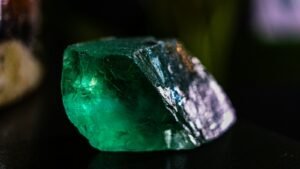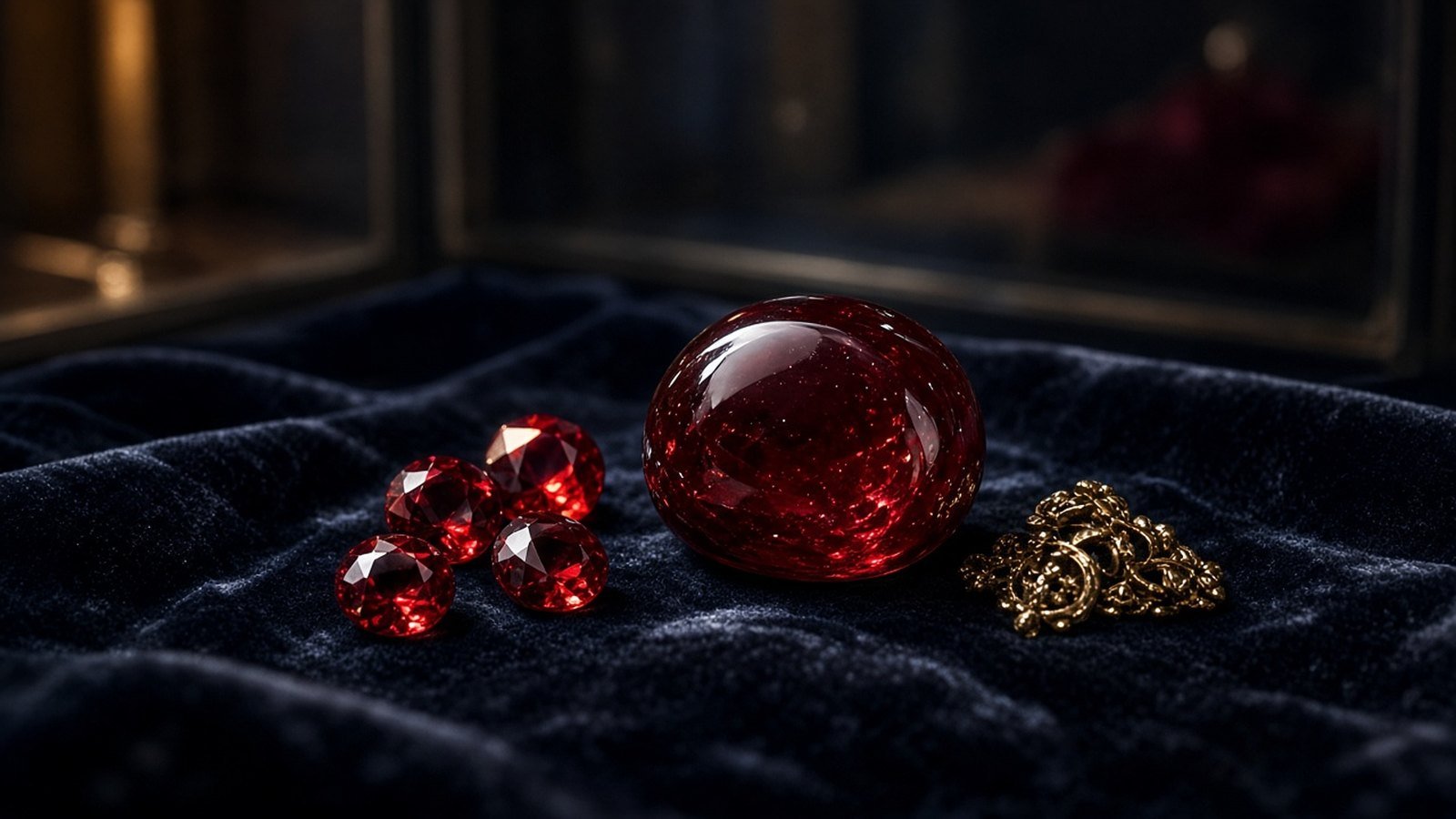
Some of the most famous “rubies” in history are not rubies at all. For hundreds of years, kings, emperors and their jewellers prized large red stones they called rubies, only for later science to reveal that many of them were a different mineral entirely: spinel. The story of how the mix-up happened, and how it was finally untangled, is one of the more surprising chapters in the history of gemstones.
The Black Prince’s Ruby
The best-known example sits at the front of the Imperial State Crown, just above the Cullinan II diamond. According to Historic Royal Palaces, which cares for the Crown Jewels at the Tower of London, the so-called Black Prince’s Ruby is in fact a balas, or spinel. Legend says it was given in 1367 to Edward of Woodstock, the “Black Prince”, by Pedro of Castile, and that Henry V wore it on his helmet at the Battle of Agincourt in 1415. Historians treat parts of that tale with caution: a 2018 study in the Spanish art history journal Atrio argues that the widely repeated Granada origin story is poorly founded.
What is better documented is the stone itself. It is an irregular, polished red spinel of around 170 carats, thought to have been mined in Badakhshan, in present-day Afghanistan, the main source of large spinels in the Middle Ages.
Why the confusion lasted so long
Ruby and red spinel look remarkably alike, and they are often found in the same deposits. Ruby is a variety of corundum, the same mineral as sapphire, while spinel is a magnesium aluminium oxide. Without modern instruments, colour alone could not tell them apart, so traders described the lighter-toned stones as “balas rubies” and treated them as a kind of ruby.
The turning point came in 1783. As the Gemological Institute of America (GIA) explains, the French mineralogist Jean-Baptiste Louis Romé de l’Isle measured the angles between crystal faces with a contact goniometer and showed that corundum and spinel form crystals of different shapes, so they had to be separate minerals. GIA describes this as a step that helped give birth to the science of gemmology. In the years that followed, other celebrated “rubies”, including the Timur Ruby set into a necklace for Queen Victoria, were recognised as spinels.
A legacy in today’s jewellery
Spinel has since earned its own following, and GIA notes it has been added as a birthstone for August. True rubies, meanwhile, remain among the most treasured red gems, valued for their colour and hardness. If the story has you thinking about red stones, our ruby rings, such as the Natural Ruby Classic Halo Ring, carry a little of that long royal tradition.
Sources: Historic Royal Palaces (The Crown Jewels, Tower of London); Gemological Institute of America (Historical Reading List: Ruby and Balas Ruby; Spinel overview); International Gem Society (Four Famous Spinels); Atrio. Revista de Historia del Arte (2018).