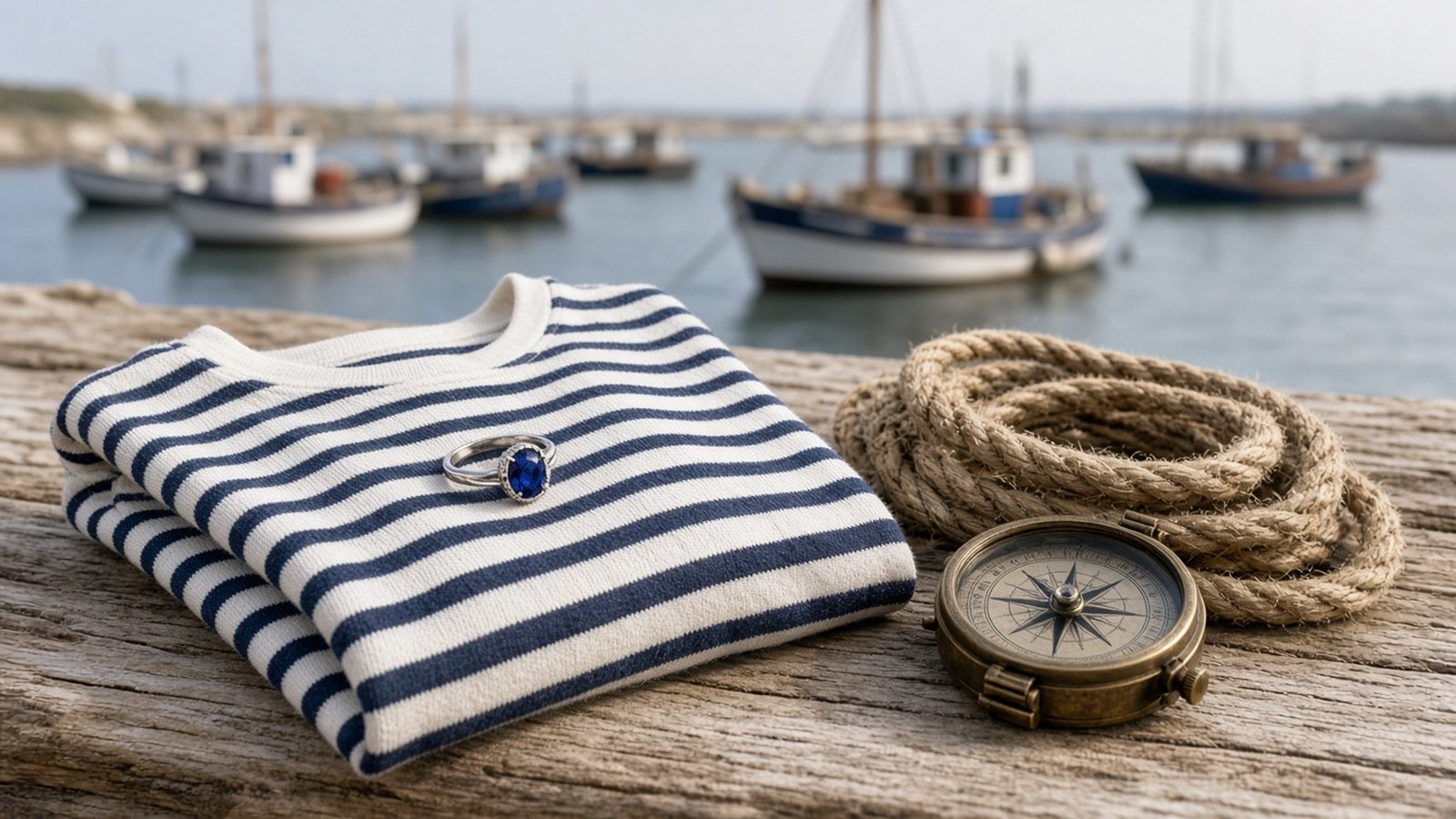
Few garments are as instantly recognisable as the blue-and-white striped top. Today it turns up everywhere from Paris boutiques to British high streets, but it began as hard-wearing workwear for fishermen and sailors on the coasts of northern France.
From fishing boats to a naval rulebook
Stripes had long been part of life at sea. Royal Museums Greenwich notes that 18th-century seamen wore vertically striped trousers, and the National Maritime Museum even holds a pair of striped socks that belonged to Nelson. The striped top itself grew out of the close-knit woollen shirts worn by fishermen in Brittany and Normandy, designed to keep out wind and spray.
It became official on 27 March 1858, when a regulation in the French Navy’s official bulletin added the tricot rayé, or striped knit, to the uniform of ordinary sailors. As the BBC and La Dépêche both report, the rules were remarkably precise: 21 white stripes, each 20mm wide, alternating with 20 or 21 blue stripes of 10mm, plus 15 white and 14 or 15 blue stripes on the sleeves. A popular story claims the 21 stripes stand for Napoleon’s victories, but there is no evidence for it. A more practical explanation, mentioned by France Today, is that the bold pattern made a sailor who fell overboard easier to spot in the waves.
The nickname “Breton” came later. Royal Museums Greenwich points out that many of the sailors came from Brittany, and the BBC adds that the travelling onion sellers of Roscoff, who crossed to Britain in striped jumpers and berets, helped fix the look in British minds.
How Chanel made it fashionable
The jump from uniform to fashion is usually credited to Gabrielle “Coco” Chanel. In the 1910s she opened a boutique in the seaside resort of Deauville and drew on sailors’ clothing for relaxed, jersey-based designs, a fabric then mostly used for men’s underwear. La Dépêche makes an interesting distinction: Chanel’s famous “marinière” pieces were sailor-collar blouses, while the striped knit was something she bought in harbour shops and wore herself, styled with loose trousers and a straw hat.
From there the stripes never really went away. Film stars and artists adopted them in the decades that followed, and designer Jean Paul Gaultier made the top a signature of his collections, as Royal Museums Greenwich notes.
Wearing the stripes today
Part of the top’s appeal is how easily it pairs with simple accessories. Navy stripes sit naturally with deep blue stones such as sapphire rings or a pair of sapphire earrings, while the pale sea-blue of aquamarine rings echoes the garment’s coastal roots.
Sources: BBC Culture, “The ultimate symbol of French cool”; Royal Museums Greenwich, “Stripes and the Sea: the History of the Breton Top”; La Dépêche, “La vraie histoire de la marinière”; France Today, “A History of the Breton Stripe”.