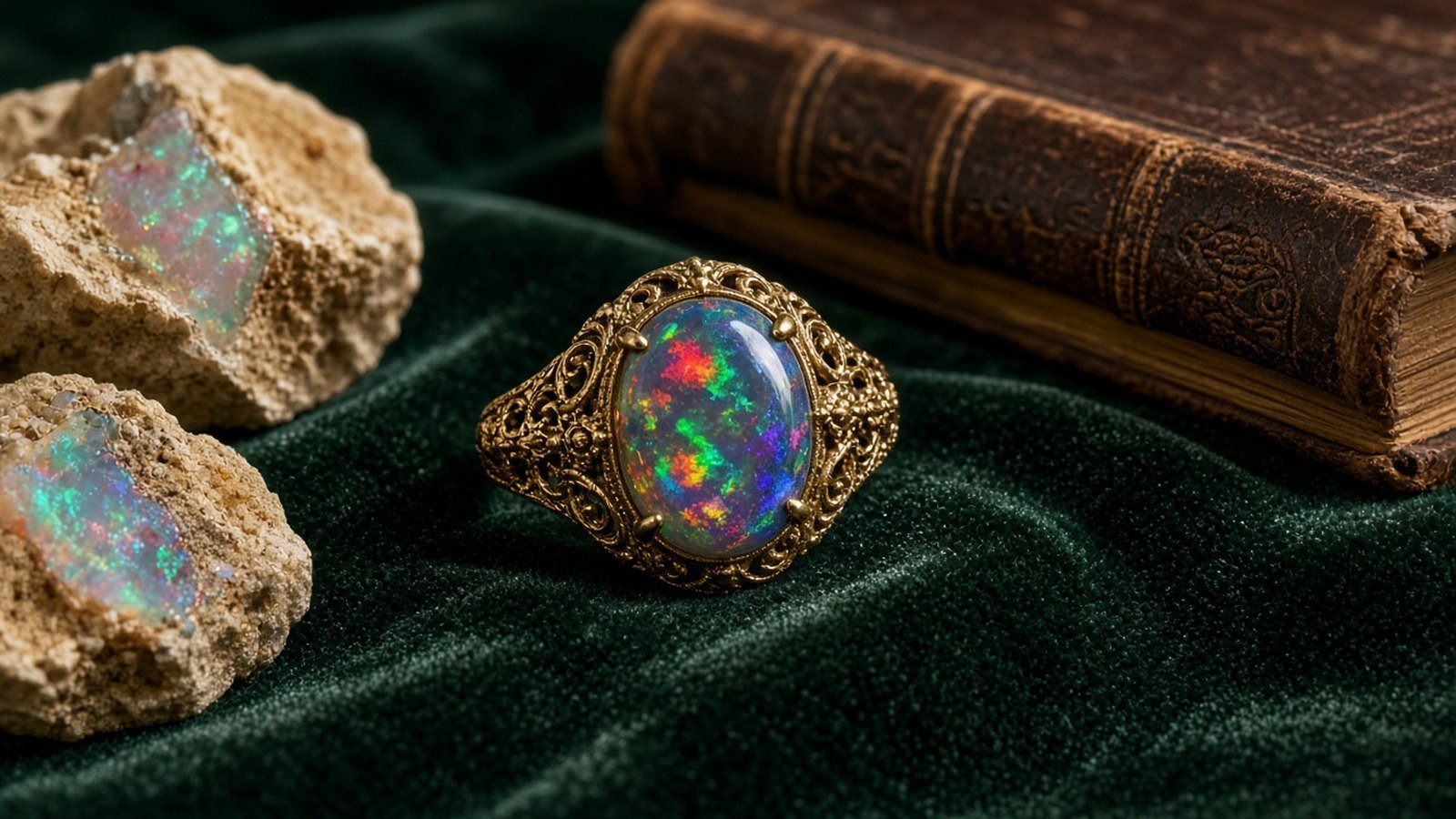
October’s birthstone has one of the strangest reputations in the jewellery box. Opal has been praised as the luckiest of all gems, blamed for misfortune, and then rescued by a queen. Its secret is “play-of-colour”, the shifting flashes of red, green, blue and violet that move as the stone is turned.
A Roman obsession
Writing in the first century AD, the Roman author Pliny the Elder said opal was the hardest gem of all to describe, because it seemed to combine the fire of a red stone, the purple of amethyst and the sea-green of emerald in a single piece. In his Natural History he also told a dramatic story about a hazelnut-sized opal ring owned by the senator Nonius. Mark Antony wanted the ring, Nonius refused to give it up, and the senator was outlawed. According to Pliny, he fled Rome taking nothing of his wealth but that ring, which was valued at two million sesterces. For centuries afterwards, the Gemological Institute of America (GIA) notes, opal was widely seen as a lucky and almost magical stone, precisely because it shows every colour at once.
A novel and a queen
The idea that opal is unlucky is surprisingly modern. GIA traces it to Sir Walter Scott’s 1829 novel Anne of Geierstein, in which a character wears an enchanted opal that loses its colour when touched by a drop of holy water, shortly before she dies. The story was so popular that opal sales in Europe are reported to have fallen sharply in the years that followed. The stone’s image recovered largely thanks to Queen Victoria, who loved opals, wore them throughout her reign and gave opal jewellery to her daughters. Because the British court set the tone for fashion, opal was soon in demand again.
The Australian chapter
The revival came just as a new source appeared. According to Geoscience Australia, precious opal was first mined commercially at Listowel Downs in Queensland in 1875, followed by White Cliffs in New South Wales. In 1903 the prospector Charlie Nettleton sold the first parcel of dark opal from Lightning Ridge, a type that buyers had at first thought too dark to be valuable. Today, as the Australian Museum explains, Lightning Ridge supplies most of the world’s black opal. In 1915 a teenage boy on a gold-prospecting trip found opal at what became Coober Pedy in South Australia. Australia now produces around 95% of the world’s precious opal, and opal is its official national gemstone.
From Roman senators to Victorian princesses, opal has always been worn by people who like a little drama. If it is your birthstone, or simply your favourite colour show, browse our opal rings, try the natural opal classic halo ring for a vintage feel, or pair it with our opal earrings.
Sources: Pliny the Elder, Natural History, Book 37 (Perseus Digital Library, Tufts University); Gemological Institute of America (GIA), “Opal History and Lore”; Geoscience Australia, “Opal” (Australian mineral facts); The Australian Museum, “Opal”; Lightning Ridge Historical Society, “Discovery of Opal”.