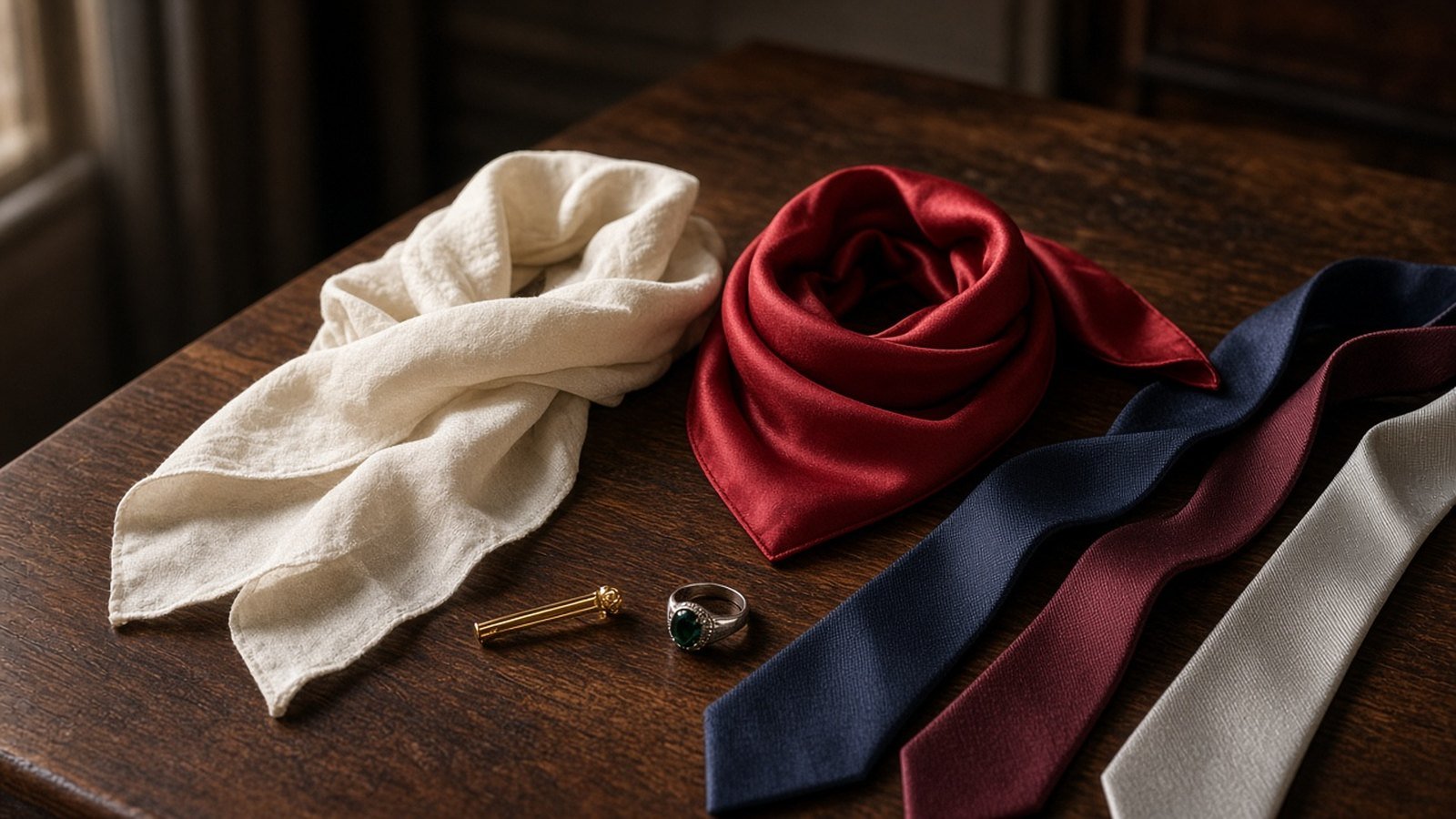
Every year on 18 October, Croatia celebrates Cravat Day, a reminder that the humble necktie has a surprisingly dramatic past. Long before it became part of the office uniform, the tie began life on the battlefields of 17th-century Europe.
Croatian horsemen and a king’s favourite accessory
As NPR explained earlier this year, the story starts in the Thirty Years’ War (1618–1648), when Croatian light cavalry fought across Europe. Historians quoted by NPR say the riders wore distinctive scarves, often red, of silk or cotton, which shielded them from cold and smoke and could double as a bandage. French sources recorded “cravate” first as a word for a Croatian cavalryman, around 1630, and then, by about 1650, for the band of fabric worn around the neck, according to the research body Academia Cravatica. Parisians copied the look “à la croate”, and Louis XIV made it a court essential; in 1667 he founded a cavalry regiment, the Royal Cravates, which lasted until the French Revolution. From French, the word spread into English as “cravat”, German as “Krawatte” and Italian as “cravatta”.
Starch, dandies and 1818’s guide to knots
In Regency London, the cravat became a test of elegance. Beau Brummell famously wore his linen neckcloth starched and tied with great precision; stories describe his valet carrying away armfuls of crumpled “failures”. In 1818 a satirical pamphlet, Neckclothitania, published with engravings associated with George Cruikshank, gave names to the fashionable knots, from “The Oriental” to “The Mathematical” and “The Horse Collar”. By the 1830s, silk had become common for neckwear.
The modern tie takes shape
The tie as we know it owes a lot to an American tie maker, Jesse Langsdorf. His US patent, filed in 1922 and granted in 1923, describes silk cut on the bias with a bias-cut lining joined by loose stitching, which let the tie stretch and spring back instead of twisting out of shape. Time magazine notes that by the 1950s a man was hardly thought fully dressed without one. Today Cravat Day itself dates from 18 October 2003, when Academia Cravatica wrapped an 808-metre red cravat around the Roman arena in Pula; the Croatian Parliament formally recognised the day in 2008.
A tie is still one of the few accessories that sits right at the centre of an outfit, and it pairs naturally with a bold men’s ring such as our Natural Peridot Men’s Ring. And if that famous Croatian red appeals, take a look at our ruby rings.
Sources: NPR, “How the word ‘cravat’ came from the battlefields of 17th century Europe” (21 January 2026); Academia Cravatica, “Cravate in the French Language”, “When Knots Acquire Names” and “The Pula Arena and the Cravat”; Zagreb Tourist Board (Love Zagreb), “The Cravat Regiment”; Cabinet magazine, “A Poet of Cloth”; US Patent 1,447,090 (Google Patents); Time, “A Brief History Of: The Necktie”; Croatian Parliament, “The Cravat Day celebrated on the Saint Mark’s Square” (2013).