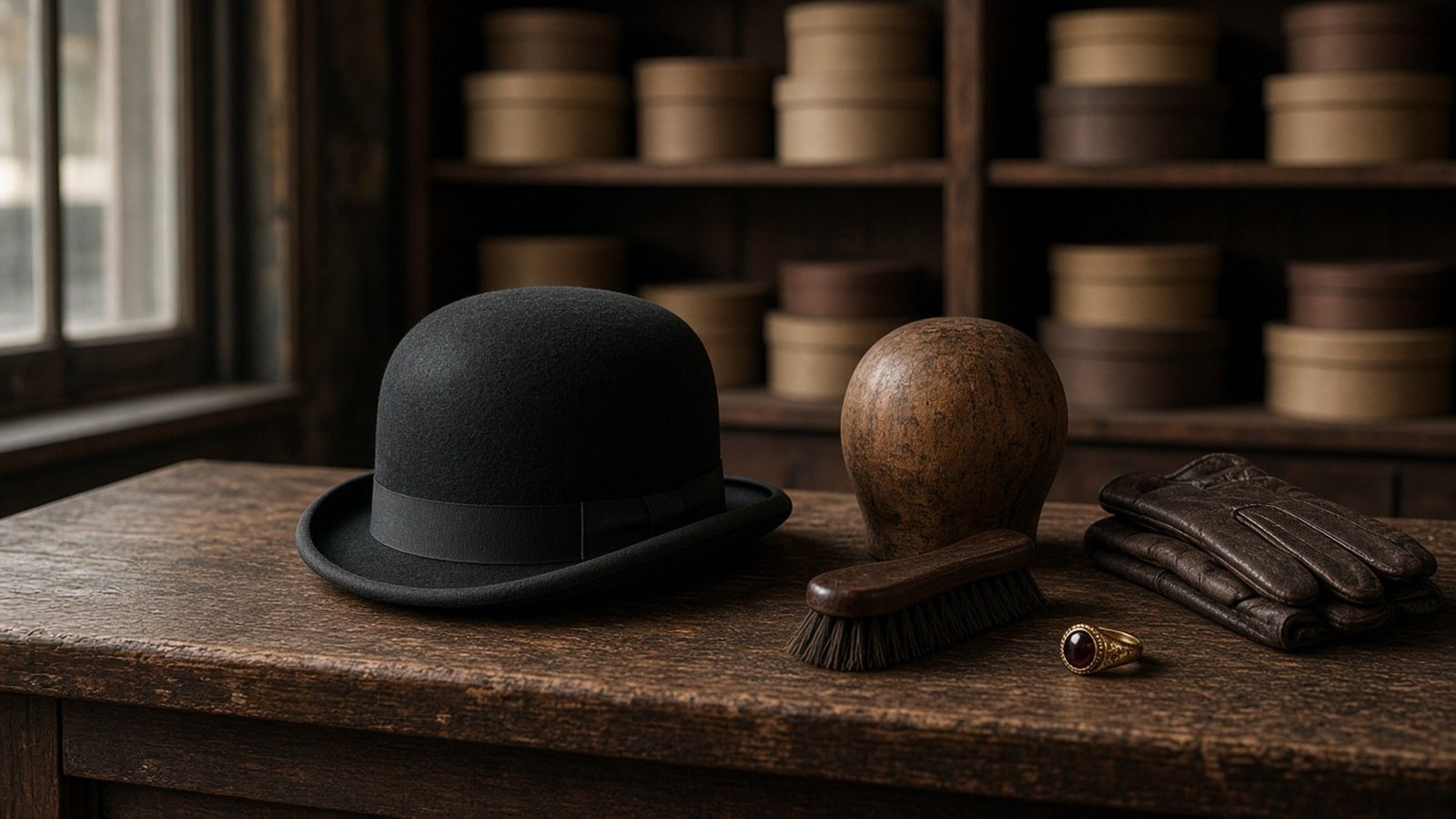
Few hats say “London” as quickly as the bowler. Yet it was not designed for bankers or civil servants. It began in 1849 as practical work gear for gamekeepers on a Norfolk country estate, and only later became a symbol of the City, the Wild West and the Bolivian highlands.
A hat built to survive branches
According to Lock & Co., the St James’s hatters who took the order, the customer was Edward Coke, younger brother of the 2nd Earl of Leicester. His gamekeepers at Holkham Hall wore tall top hats, which were easily knocked off and damaged by low branches as they rode. Coke wanted something close-fitting, hard and low-crowned. Some accounts, as the On This Day archive notes, name a different member of the Coke family, but the story is otherwise the same.
Lock & Co. passed the job to hat-makers Thomas and William Bowler. A 1978 Washington Post report describes the result as a fur-felt hat stiffened with shellac. The best-known part of the tale comes next: on 17 December 1849, Coke is said to have put the new hat on the floor and stamped on it. It held its shape, and he paid 12 shillings. Lock & Co. still lists the style as the “Coke”, following its habit of naming a hat after the client who ordered it, while most of the world calls it after its makers.
From cowboys to the City
The hat travelled fast. In the United States it became known as the derby, and, as HistoryNet recounts, the writer Lucius Beebe argued in a 1957 newspaper column that this, not the wide cowboy hat, was “the hat that won the West”. He pointed to wearers such as the lawman Bat Masterson and the stagecoach robber known as Black Bart. A hard, snug crown simply stayed on better in the wind.
In Britain the bowler moved from the countryside to the office. For much of the 20th century it was part of the City uniform, alongside the dark suit and rolled umbrella, and comedians such as Charlie Chaplin and Laurel and Hardy made it famous on screen. Discover Britain notes that Holkham’s tradition still continues: the Earl of Leicester gives his gamekeepers a Coke hat after a year’s service.
A highland icon
Perhaps the most surprising chapter is in South America. Discover Britain reports that British railway workers brought bowlers to Bolivia in the 1920s, and Quechua and Aymara women adopted them. Today the bombín, worn with a full skirt, a fringed shawl and plenty of jewellery, is one of the best-known images of Andean dress.
A classic accessory tends to last when it is simple and well made. The same idea runs through our men’s rings, our garnet earrings and our coordinated jewellery sets.
Sources: Lock & Co. Hatters, “Bowler Hat History: Why Is It Called a Bowler Hat?”; On This Day, “Bowled Over by William and Harry”; The Washington Post, “The Hatter That Begat the Bowler” (31 August 1978); HistoryNet, “Stetson Invented the Cowboy Hat, Westerners Gave It Wings”; Discover Britain, “The history of the British bowler” (26 May 2017).