
Few garments have caused as much fuss for so little fabric as the bikini. Its story begins in the first peacetime summer after the Second World War, with two rival Frenchmen, an atomic test and a public swimming pool in Paris.
The Atome and the Bikini
In spring 1946 the Paris couturier Jacques Heim launched a small two-piece swimsuit he called the Atome, promoted as “the world’s smallest bathing suit”. According to Smithsonian Magazine, it still covered the navel. Within weeks Louis Réard, an automobile engineer who had taken over his mother’s lingerie business in Paris, answered with something even smaller: four triangles of cloth joined by string, using roughly 30 square inches of fabric.
Réard named it after Bikini Atoll in the Pacific, where the United States had carried out a widely reported nuclear test on 1 July 1946. He was betting the swimsuit would make just as many headlines, and he even had it printed with a newspaper-type pattern.
A debut at the Piscine Molitor
The bikini was shown on 5 July 1946 at the Piscine Molitor, a fashionable Art Deco pool in Paris. HISTORY reports that professional models refused to wear it, so Réard hired Micheline Bernardini, a dancer at the Casino de Paris. The Metropolitan Museum of Art notes that the poolside show is officially the bikini’s first appearance at a fashion event, though both Heim and Réard claimed to have been first, and young women on the beaches of Cannes had already been rolling their swimsuits as small as they dared to chase the new fashion for a suntan.
Réard also had a famous test: a true bikini, he said, could be pulled through a wedding ring. Acceptance came slowly. Smithsonian Magazine records that the Vatican condemned the design and several US states banned it from public beaches, and it took film stars and the beach culture of the 1950s and 1960s to make it ordinary summer wear.
Still a summer staple
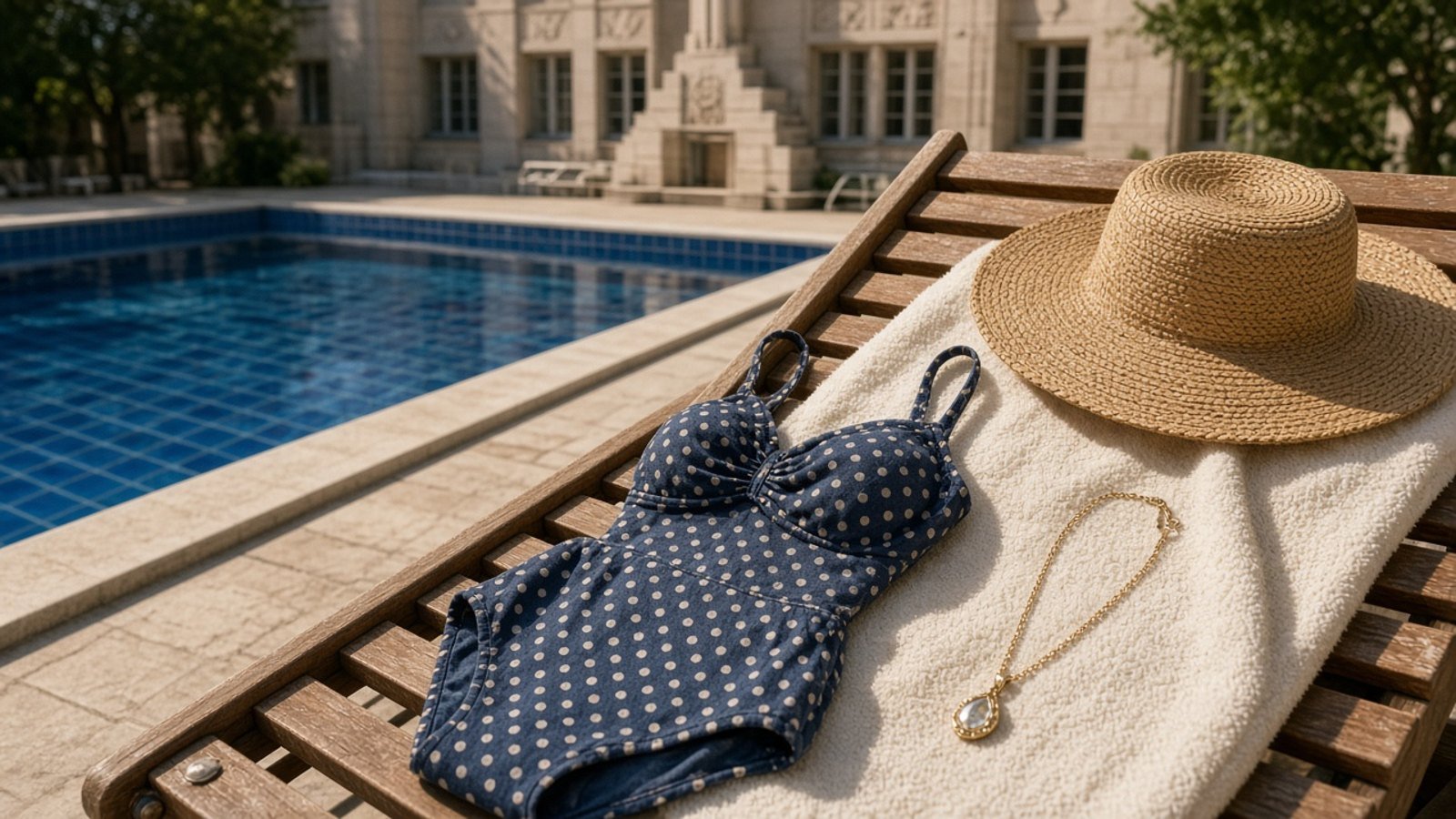
Eighty years on, the bikini is so familiar that it is hard to imagine the scandal. Holiday dressing today often pairs it with a few light pieces of jewellery that can go from the beach to dinner, such as delicate earrings, a slim pendant necklace or a stack of bracelets.
Sources: HISTORY, “Bikini introduced, July 5, 1946”; Smithsonian Magazine, “How the Summer of Atomic Bomb Testing Turned the Bikini Into a Phenomenon”; The Metropolitan Museum of Art, “The Bikini” (Heilbrunn Timeline of Art History); The Globe and Mail, “Four triangles of nothing: How the bikini was born 70 years ago”.


