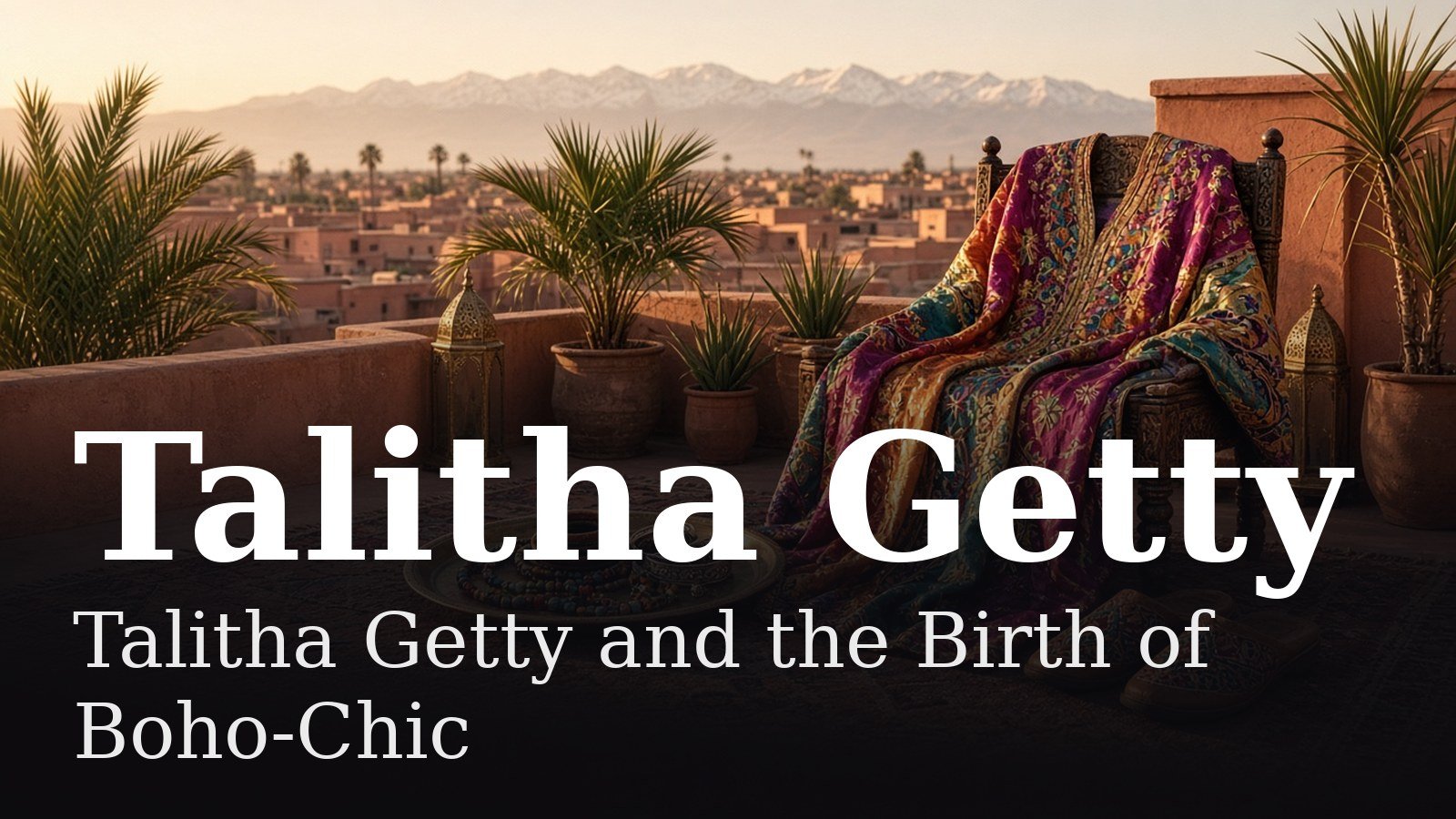
Long before “boho-chic” became a shorthand for festival season, Talitha Getty was quietly writing its rules. She never designed a collection or launched a label, yet more than half a century after her death designers still return to her wardrobe. Vanity Fair Italia has just revisited her story, and it is a reminder of how much of today’s relaxed, well-travelled style began with one woman in Marrakech.
From Java to Swinging London
She was born Talitha Dina Pol in October 1940 on Java, then part of the Dutch East Indies. Her childhood was far from privileged: during the Second World War she and her mother were held in a Japanese internment camp. After the war she settled in England, trained as an actress at RADA in London and took small film roles in the 1960s, including an appearance in Barbarella.
Her real stage, though, was society. In December 1966 she married the oil heir John Paul Getty Jr. in Rome, and even her wedding look broke the mould: instead of a long white gown with a sweeping train, she chose a short dress trimmed with mink.
The rooftop that defined a look
The couple made their home in a 17th-century palace in the Marrakech medina, which became a magnet for the international jet set, from Mick Jagger and Paul McCartney to Yves Saint Laurent. In January 1969 Patrick Lichfield photographed them on its rooftop for Vogue: Talitha crouching in a multicoloured kaftan, white harem trousers and white boots, her husband in a hooded robe behind her. That portrait, now held by the National Portrait Gallery in London, is still one of the most referenced fashion images of the era.
What made her style so lasting was the mix. Moroccan kaftans, embroidered Palestinian dresses, Balinese fabrics, wide trousers and soft slippers were layered with wooden bracelets, Persian bead necklaces, bold belts and jewellery collected on her travels. It was the free spirit of the Sixties, but polished and cosmopolitan rather than scruffy. Saint Laurent’s partner Pierre Bergé recalled that although she could afford any couture house, she preferred to build her own look, and that freedom fed into the designer’s own love of kaftans and Moroccan colour.
A short life, a long legacy
Her story ended far too soon: she died in Rome in July 1971, aged just 30, leaving a young son. Yet her influence is everywhere, from Phoebe Philo’s early collections for Chloé to resort lines at Valentino and Saint Laurent. To borrow a little of her ease, start with jewellery: stack a few bracelets and bangles, layer colourful necklaces, and finish with statement earrings.
Sources: Vanity Fair Italia, “Talitha Getty, l’ascesa e la tragica fine della pioniera del boho-chic” (23 October 2026); National Portrait Gallery, London (portrait NPG x126959 by Patrick Lichfield, January 1969); Vogue, “Throwback Bohemian Style Inspiration from Talitha Getty in Marrakech”. Featured image: AI-generated illustration, not a historical photograph.