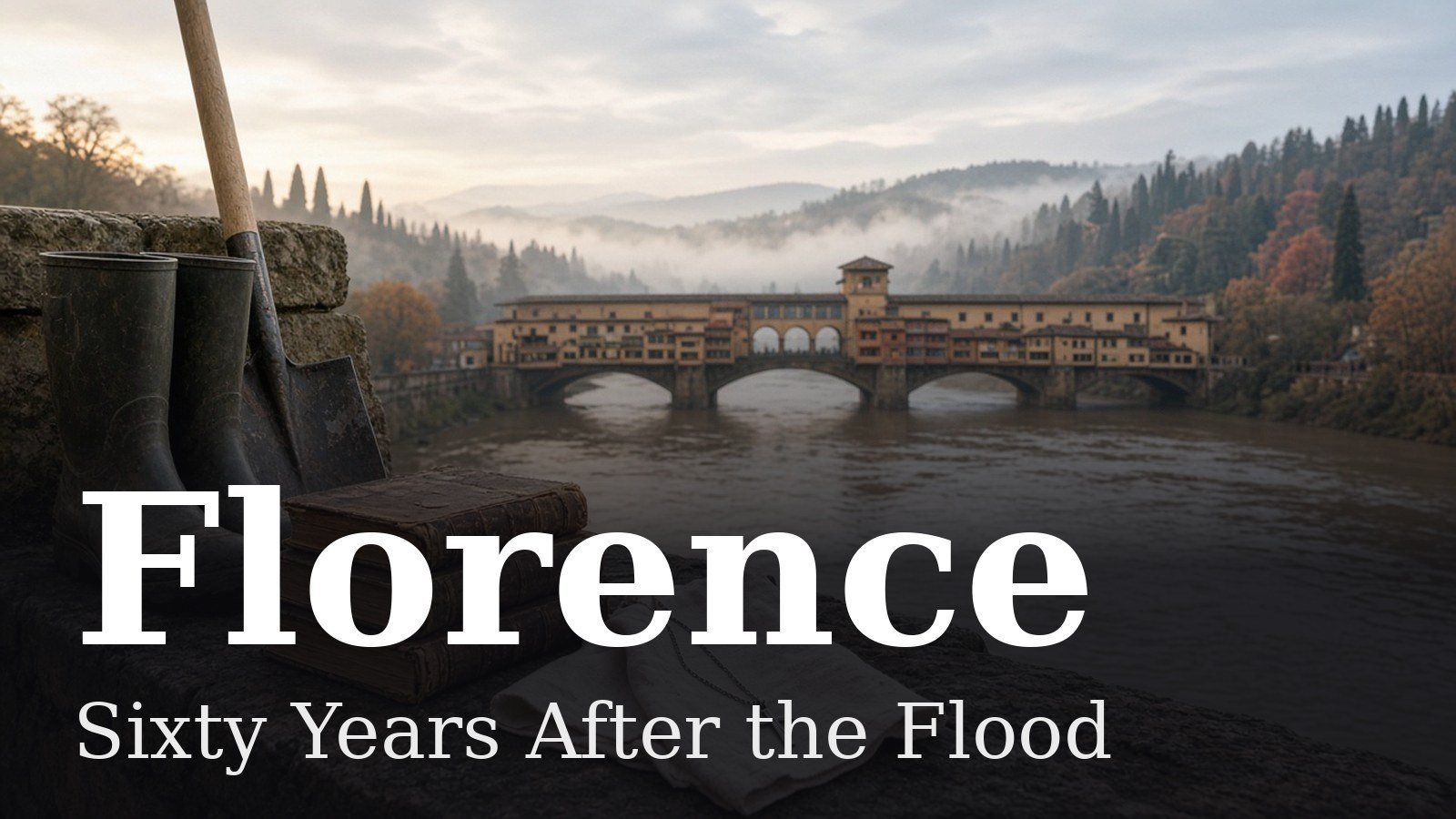
Sixty years ago, on the night of 3 to 4 November 1966, the Arno broke its banks after days of heavy rain and poured into Florence. Water and thick mud swept through streets, homes, churches, libraries and museums. Thirty-six people lost their lives, thousands of animals died, and countless books, documents and works of art were damaged. Yet what Florence remembers most this week is not only the destruction, but the extraordinary wave of help that followed.
The Mud Angels
Within days, young volunteers arrived from across Italy and from more than seventy countries. They became known as the angeli del fango, the Mud Angels, shovelling sludge from cellars and shops and carrying waterlogged volumes out of the National Central Library. One of them was the Italian politician Pier Luigi Bersani, then a teenager, who travelled from Piacenza in a minibus with fourteen friends. As recounted by Vanity Fair Italia, he remembers that the work was far less romantic than the television images suggested: up at seven, boots on, wheelbarrow and spade. His group cleared a goldsmith’s workshop and pulled out a whole barrow of jewellery. When they finished, the grateful jeweller gave each of them a small silver chain with a cross for their mothers, and Bersani’s mother kept hers for the rest of her life.
The mayor at the time was Piero Bargellini, grandfather of today’s mayor, Sara Funaro. Family stories describe his home in Santa Croce filled with mud, which he insisted should be the last to be cleaned so that visitors could see what the city had suffered.
Sixty years of memory and restoration
Florence is marking the anniversary with a full programme. On 4 November a Mass is held in the Basilica of Santa Croce, followed by a procession to the river and a tribute to the Mud Angels in the Salone dei Cinquecento attended by President Sergio Mattarella. The State Archive, whose collections were then kept at the Uffizi, opens Ri-emergere 1966–2026, an exhibition on the rescue, drying and restoration of flooded records, running until early February 2027. The Teatro della Pergola stages a new play about the volunteers, and an Italian Red Cross photo exhibition at Santa Maria Novella station recalls the international aid that reached the city.
The flood also gave birth to modern conservation science, as restorers invented new ways to save paper, panels and canvas. It is a reminder that treasured objects, from a library book to a simple silver chain, carry the stories of the people who cared for them. If that idea speaks to you, browse our pendant necklaces, necklaces, bracelets and rings, or a sturdy tote bag for exploring Florence’s exhibitions this autumn.
Sources: Vanity Fair Italia, The Florentine, Feel Florence (City of Florence), Feel Florence: Ri-emerging exhibition.