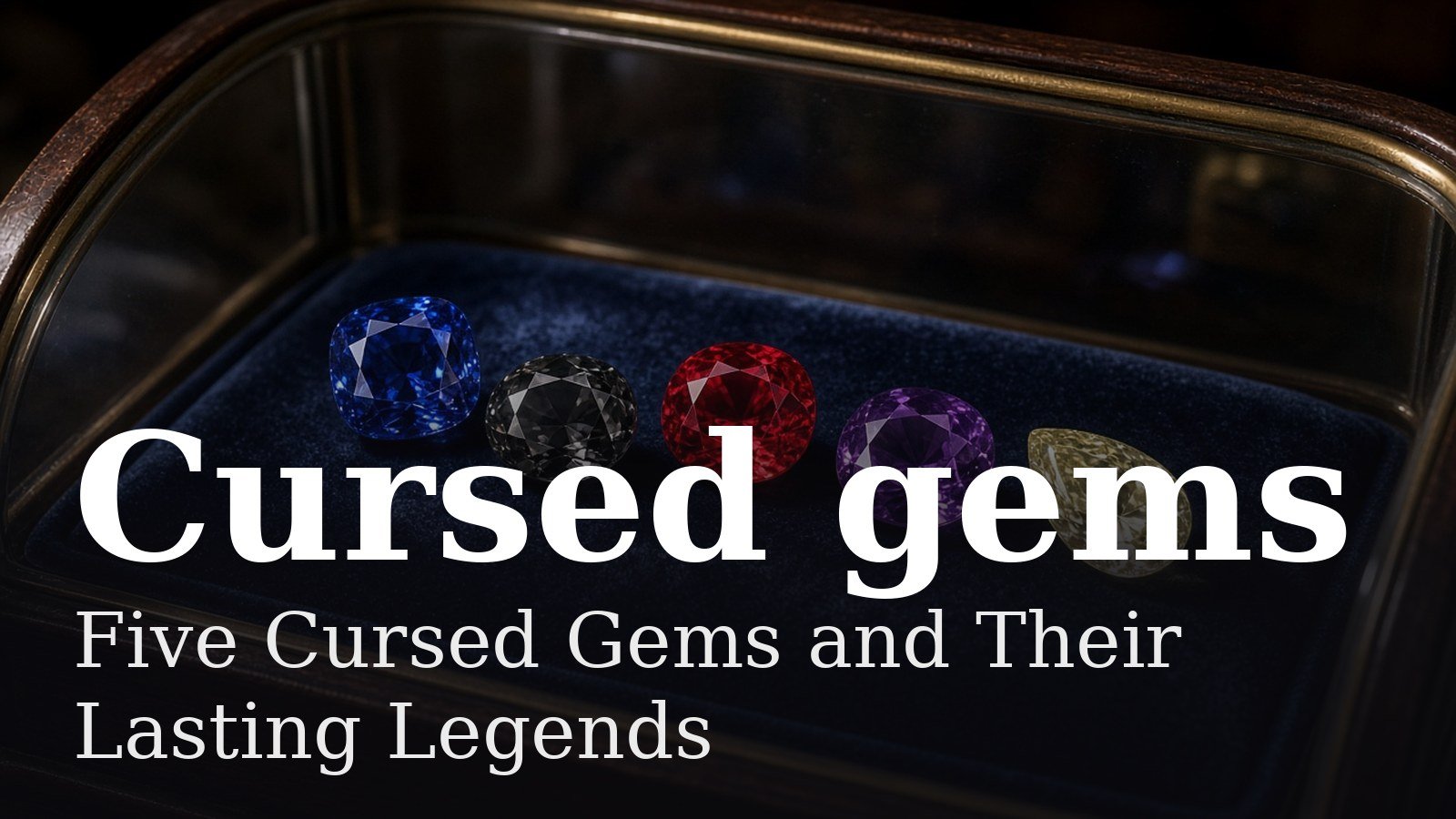
Vanity Fair Italia has returned to five historic gems whose sparkle is matched by a reputation for misfortune. The tales are often embroidered to make a stone more desirable. Set the folklore aside, and what remains is a group of extraordinary jewels now kept behind museum glass.
Blue, black and a pale yellow survivor
Most of the legends begin around Golconda, near present-day Hyderabad in India, once the source of the world’s finest diamonds. Gem historians are usually drier: stones that have changed hands for centuries will, by ordinary chance, sit beside wars, bankruptcies and early deaths. Pierre Cartier understood the value of a shiver. When he sold the Hope Diamond to Evalyn Walsh McLean in 1911, he made sure she heard the curse as clearly as she saw the colour.
The Hope Diamond is the best documented of the five. Jean-Baptiste Tavernier sold a large blue diamond from India to Louis XIV in 1668. Recut as the French Blue, it vanished when the French Crown Jewels were looted in September 1792, then resurfaced in London as the 45.52-carat deep-blue stone later named after Henry Philip Hope. Harry Winston donated it to the Smithsonian Institution in 1958, sending it to Washington by registered post.
The Black Orlov, a 67.49-carat fancy black diamond set in a necklace, has a thinner paper trail. Folklore says it was taken from a statue of Brahma and later linked to several suicides. Researchers place its first authenticated owner in mid-twentieth-century New York, where dealer Charles Winson had a larger stone divided. It was shown at London’s Natural History Museum in 2005 and sold at Christie’s the following year.
The pale yellow Sancy, 55.23 carats, now rests in the Louvre’s Galerie d’Apollon. Its first certain owner was the French diplomat Nicolas de Harlay, sieur de Sancy, who sold it to James I of England in 1604. The museum bought the diamond from the Astor family in 1976.
A ruby that is a spinel, and a sapphire that is an amethyst
Names can mislead as thoroughly as curses. The Black Prince’s Ruby, set in the Imperial State Crown at the Tower of London, is a large red spinel long mistaken for ruby. Royal history attached it to Pedro of Castile and Edward, the Black Prince, in the fourteenth century. The so-called Delhi Purple Sapphire, kept at the Natural History Museum in London, is an amethyst. Its Victorian owner, Edward Heron-Allen, left a letter warning of disaster if it were worn; modern researchers treat that account with deep scepticism.
Curses travel well. The gems themselves travel into museums, where anyone may look without claiming them. For anyone drawn to colour rather than folklore, a well-chosen ruby, sapphire or amethyst still makes the quieter point that a stone’s real power is how it is worn. Explore our jewellery collection for pieces chosen for beauty, not for myth.
Sources: Vanity Fair Italia (Valentina Bottoni, 8 November 2026); Smithsonian National Museum of Natural History; Gemological Institute of America; Musée du Louvre; National Geographic; Gemmological Association of Australia.