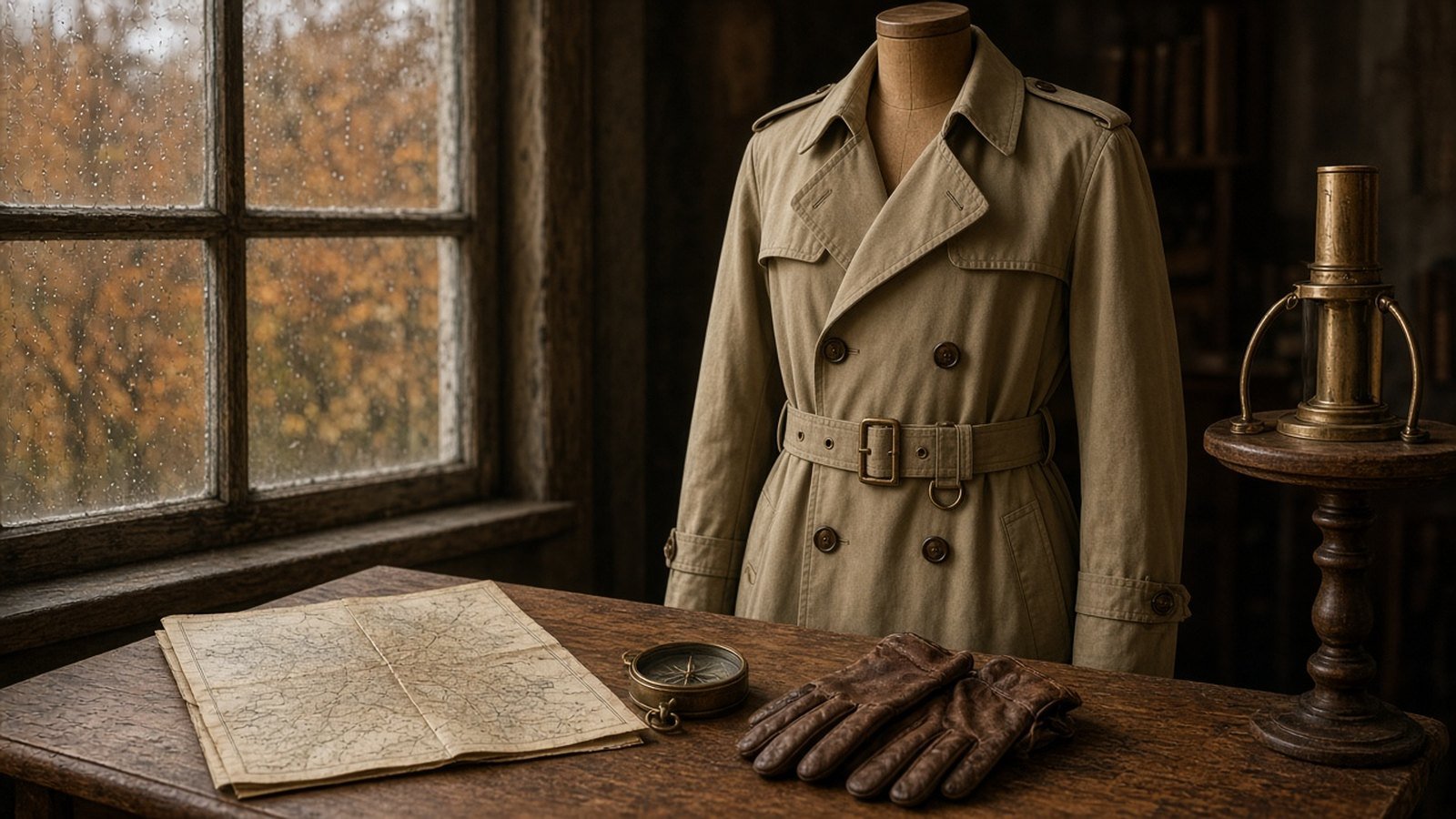
Few garments have travelled as far as the trench coat. Today it is a staple of autumn wardrobes and catwalks alike, but its familiar shape was settled more than a century ago, in the mud of the Western Front during the First World War.
From shepherds’ smocks to officers’ kit
The story begins with fabric. According to the Victoria and Albert Museum and Smithsonian Magazine, Hampshire draper Thomas Burberry patented gabardine in 1879: a tightly woven twill whose yarn was waterproofed before weaving, so the cloth stayed breathable rather than stiff and sweaty like earlier rubberised coats. He is said to have taken inspiration from the smocks worn by local shepherds. London outfitter Aquascutum, whose name comes from the Latin for “water shield”, had been making weatherproof coats since the 1850s, and both firms later claimed to have invented the trench coat. Historians quoted by Smithsonian Magazine say nobody can really be sure who came first.
What is clear is why the coat was needed. The BBC notes that the heavy wool greatcoats worn by British troops since the Crimean War were badly suited to flooded trenches. Officers, who were allowed to buy their own uniforms from tailors, turned to a shorter, lighter and water-repellent alternative. By 1916 the style was widely worn, and that year the term “trench coat” appeared in print in a tailoring trade journal.
Every detail had a job
Many features that look purely decorative today were practical. As Smithsonian Magazine explains, the belt carried D-rings for hooking on equipment such as map cases or binoculars, the shoulder straps showed rank, and the storm flap and back yoke helped rain run off. Deep pockets kept maps dry, strapped cuffs kept out the weather, and the buttoned collar offered extra protection. The knee length was short enough to stay clear of the mud, yet long enough to cover most of the body.
From the trenches to the silver screen
After 1918, many former officers kept wearing their coats, and the V&A describes how demobilised soldiers brought the style into towns and cities. Hollywood did the rest. Humphrey Bogart wore one in The Maltese Falcon (1941) and Casablanca (1942), and Marlene Dietrich wore one in A Foreign Affair (1948), a coat later shown in a Hampshire exhibition listed by the Imperial War Museums. The trench coat became shorthand for detectives, spies and anyone who looked as though they had seen a thing or two.
More than a hundred years on, the classic beige trench still pairs easily with warm autumn colours. A deep red garnet ring such as the Natural Garnet Branch Leaf Ring, or a honey-toned topaz ring, is an easy way to echo the season, while small stud earrings sit neatly beside a buttoned collar.
Sources: Smithsonian Magazine, “The Classy Rise of the Trench Coat” (2015); Victoria and Albert Museum blog, “Trench coats: from real mud to Nostalgia of Mud”; BBC News, “The trench coat’s forgotten WW1 roots” (2014); Imperial War Museums, “Trench Coat: From field to fashion”; The Conversation, “From the Somme to the catwalk: the story of the trench coat”.