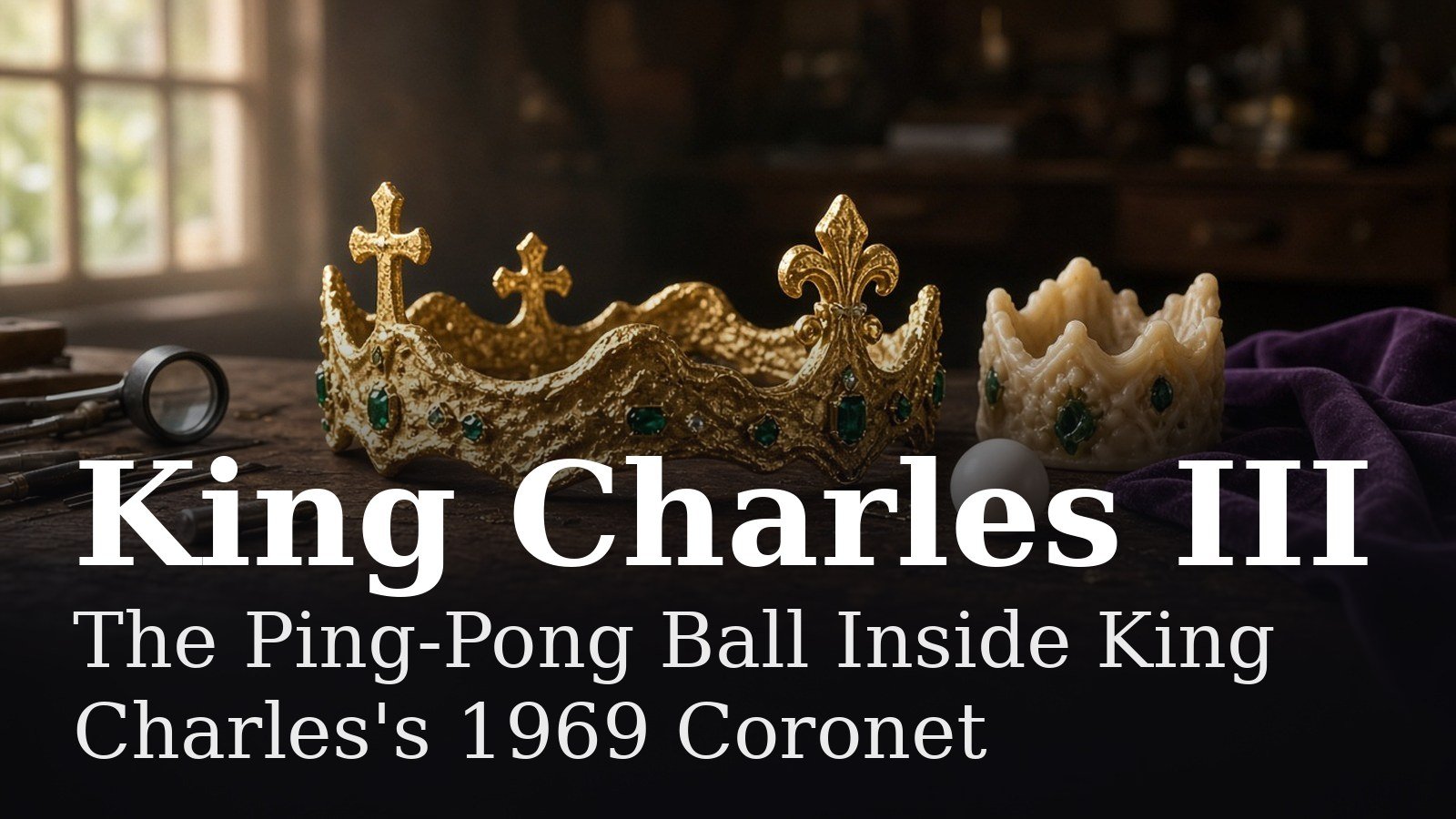
Royal regalia is usually about centuries of tradition, but one of King Charles III’s most personal pieces hides something rather ordinary. Inside the gold orb at the top of the coronet he wore at his investiture as Prince of Wales, at Caernarfon Castle on 1 July 1969, sits a table-tennis ball. It cannot be seen, it cannot be removed, and for years it was reportedly a secret even to the prince himself.
A crown of its own time
Charles needed a new coronet because the previous one had left Britain with the Duke of Windsor after his abdication. The Goldsmiths’ Company commissioned the architect and goldsmith Louis Osman, and presented the finished piece to Queen Elizabeth II for her son’s ceremony. The young prince is said to have asked for a crown that belonged to his own era, and Osman delivered. Rules dating back to Charles II still required crosses, fleurs-de-lis, a single arch and an orb, but he turned them into abstract, almost lightning-like forms with an irregular, organic gold surface.
The making was just as unconventional. Instead of hammering or casting the metal, Osman’s team used electroforming, in which an electric current deposits gold onto a mould so the finished shell copies every detail of the model. Chemist David Mason worked on the process, and it did not go smoothly: one mould melted the wax model, and an early version shattered when it was struck with its hallmark.
How the ball got inside
The seamless orb was the last problem, with the ceremony only days away. Mason has said the idea came while watching table tennis on television. A ping-pong ball was pierced, threaded with fine copper wire, coated with silver so it would conduct, then left in the gold bath for about two days. Once the orb had been engraved with the Prince of Wales’s insignia by Malcolm Appleby and mounted, there was no way to take the ball out, so it stayed.
Emeralds, diamonds and a star sign
Around the orb, 13 diamonds trace the constellation of Scorpio, Charles’s star sign. Diamonds set horizontally stand for the seven gifts of God on one side and the seven deadly sins on the other. The four crosses and four fleurs-de-lis were made from a nugget of Welsh gold, and green emeralds nod to Wales. With 24-carat gold, platinum and a purple velvet and ermine cap, it remains one of the most modern pieces of British regalia. Since 2020 it has been on display in the Jewel House at the Tower of London.
If the coronet’s green and gold appeal to you, explore our emerald jewellery, from emerald rings to emerald earrings and emerald pendants.
Sources: Vanity Fair Italia; Tatler; Town & Country; The Guardian; Royal Collection Trust via Google Arts & Culture.