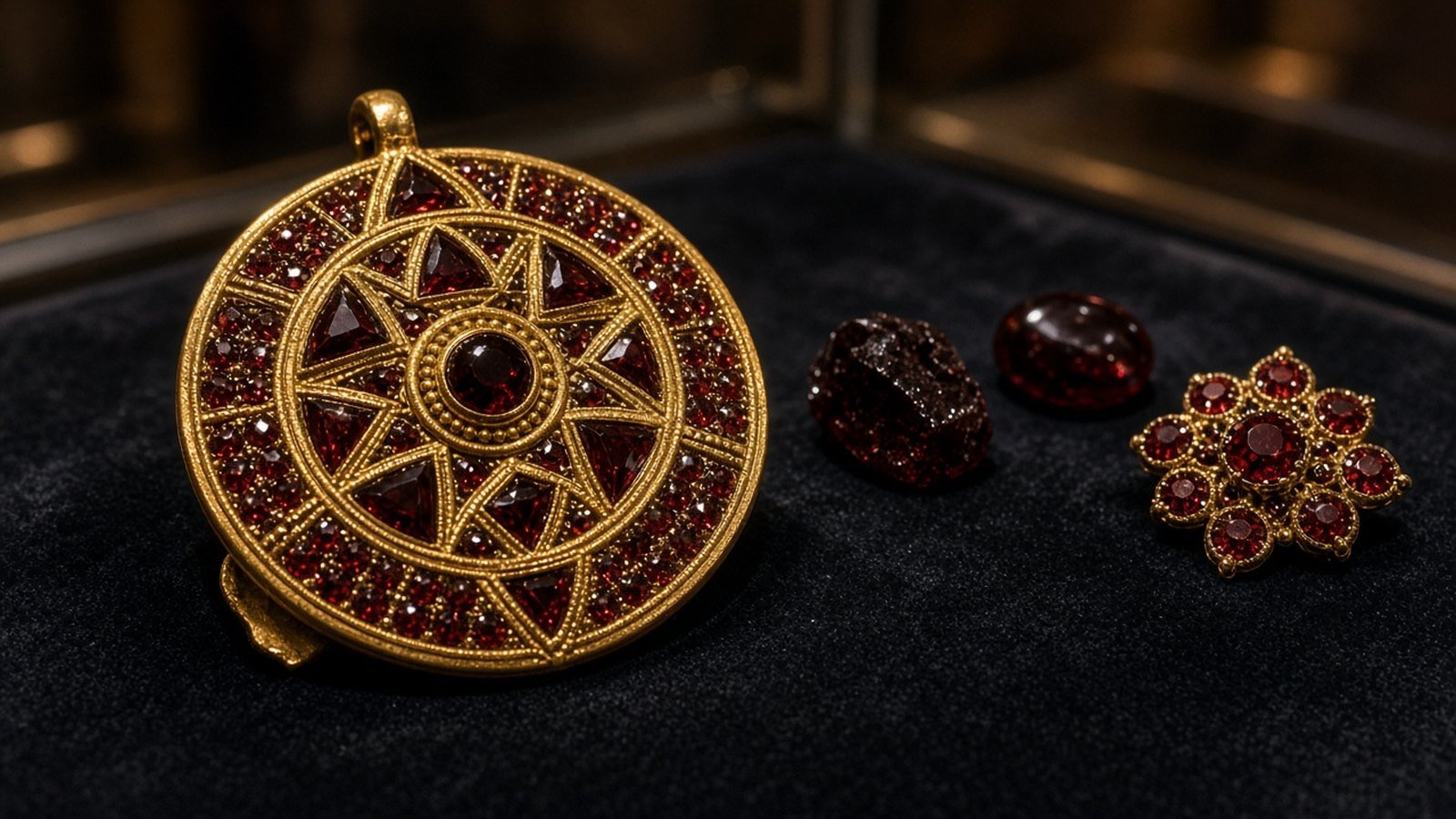
Long before diamonds dominated the jewellery box, deep red garnet was the stone of power. According to the Gemological Institute of America (GIA), red garnet necklaces were buried with Egyptian pharaohs, and Romans used signet rings carved from garnet to stamp the wax seals on important documents. In ancient times the word “carbuncle” covered almost any glowing red gem, garnet included, and by the Roman scholar Pliny’s day red garnets were among the most widely traded gems.
Gold and garnet for Anglo-Saxon kings
Garnet’s most dazzling chapter in Britain came in the early Middle Ages. From the fifth century, jewellers across Europe set thin slices of red garnet into tiny gold cells, a technique known as cloisonné. The Staffordshire Hoard, found in a field near Lichfield in 2009, shows how far the craft went: Birmingham Museums has counted more than 3,500 individually cut and mounted garnets among its gold and silver fittings, all of them red.
Where did they come from? Birmingham Museums reports two sources in the hoard: the very small stones came from what is now the Czech Republic, while the larger ones came from the Indian subcontinent. The British Museum found a similar mix at Sutton Hoo. Using a particle accelerator at a Paris laboratory, researchers traced garnets on five objects from the ship burial to India, Sri Lanka and Czechia. On one scabbard button, orange-toned Sri Lankan and Czech stones form a cross against purple Indian garnets, so the cross seems to glow. The famous Sutton Hoo shoulder clasps add two interlinked boars made of garnet cells, each stone backed with stamped gold foil to catch the light.
The Bohemian garnet boom
GIA notes that garnet became far easier to find after deposits in Bohemia, in central Europe, were discovered around 1500. These fiery red pyrope garnets (the name comes from the Greek for “fire” and “eye”) are found in the highlands roughly 60 kilometres north-west of Prague, usually as small crystals of up to about 6 millimetres. Mining began in the 16th century, and the regional jewellery industry reached its peak in the late 1800s.
Victorian jewellers made the most of those small stones, pavé-setting clusters of tiny rose-cut and brilliant-cut garnets into brooches, bracelets, crosses and rings. Because the stones were plentiful, garnet jewellery was no longer only for nobles; as a Mindat history of the stone puts it, it reached townspeople and country folk alike.
That rich wine-red is still easy to wear today, from a classic garnet ring or a pyrope garnet ballerina ring to a vintage-style garnet pendant or a pair of garnet earrings.
Sources: GIA, “Garnet History and Lore” and “Historical Reading List: Red Pyrope Garnets from Bohemia”; Birmingham Museums, “The Staffordshire Hoard research and conservation”; British Museum, “Sri Lanka to Suffolk: Sutton Hoo and the Silk Roads” and collection record for the Sutton Hoo shoulder clasp (1939,1010.5); Popular Archaeology, “Conserving the Staffordshire Hoard”; Mindat, “Bohemian garnets: the gemstone, the history and the geology”.