Few women of the twentieth century turned getting dressed into something close to an art form quite like Gloria Guinness. A new profile in Vanity Fair Italia revisits the life of the Mexican-born socialite whom the Best Dressed List founder Eleanor Lambert called “the most elegant woman in the world”, and it is a reminder that her lessons on style still feel remarkably modern.
From Gloria Rubio to the jet set
Born Gloria Rubio y Alatorre in Mexico in 1912, she told shifting stories about her early years, and much of her youth remains uncertain. What is clear is her gift for reinvention. Four marriages, including to a German count of the von Fürstenberg family and, in 1951, to the British financier Thomas Loel Guinness, carried her into international society. The couple kept homes in Paris, New York, Palm Beach and beyond, and she famously argued that running several houses was easier than running one, since nobody could spend twelve months in a single place.
Truman Capote counted her among his celebrated “swans”, alongside Babe Paley, Lee Radziwill and Marella Agnelli. Yet she wanted to observe as well as be observed: from 1963 to 1971 she was a contributing editor at Harper’s Bazaar, writing about fashion, elegance and society.
A wardrobe with a sense of place
Cristóbal Balenciaga regarded her as one of the most elegant women he ever dressed, and she also wore Givenchy, Dior, Chanel and later Halston. Her clothing budget was reported at around $250,000 a year, an extraordinary sum at the time. Even so, accounts from the period say she could look superb in nothing more than a black jumper and matching skirt.
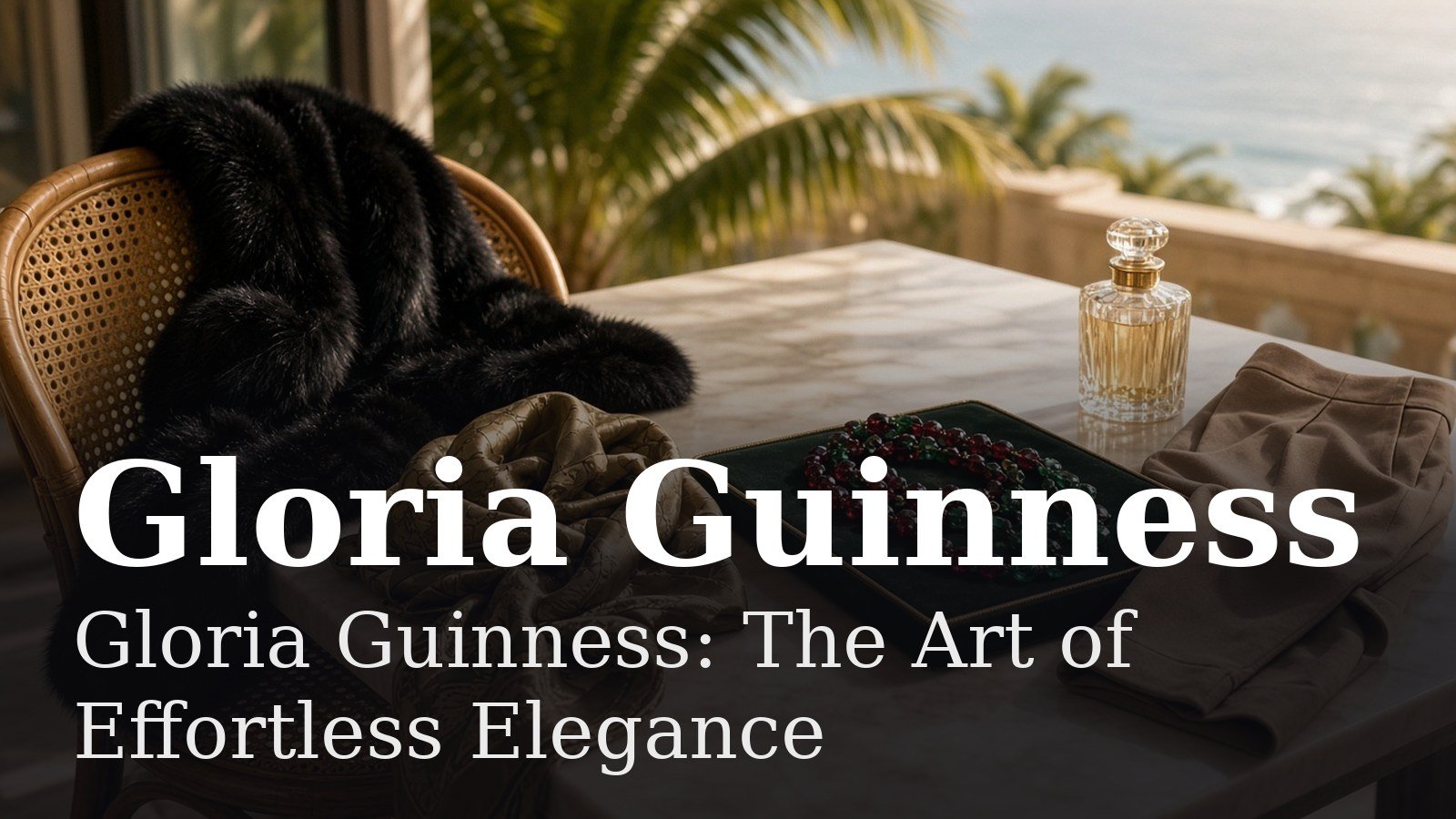
She is credited with helping to popularise slim, ankle-length Capri trousers in 1950s Palm Beach, and she favoured Emilio Pucci prints, turbans and black mink. She even planned her wardrobe by city, reportedly saving her Chanel suits for Lausanne because too many women already wore them in Paris and New York. At Capote’s Black and White Ball in 1966 she paired an Antonio del Castillo gown with intertwined ruby and emerald necklaces.
Why her style still matters
Her formula was one of calibrated contrasts: couture beside the simplest knitwear, clean lines lifted by one bold jewel. Anyone wanting to borrow the idea might start with a statement piece from our necklaces, a flash of colour from our emerald jewellery or ruby earrings, and a structured bag from our women’s handbags. Gloria Guinness died in 1980, but her central idea endures: elegance is less about the label than about knowing exactly how, and where, to wear it.
Sources: Vanity Fair Italia (Ilaria Perrotta, 7 November 2026); Vanity Fair US, “The Forgotten Swans”; WWD, “Gloria Guinness: Style Through the Years”; Vogue archive feature on Capote’s swans.