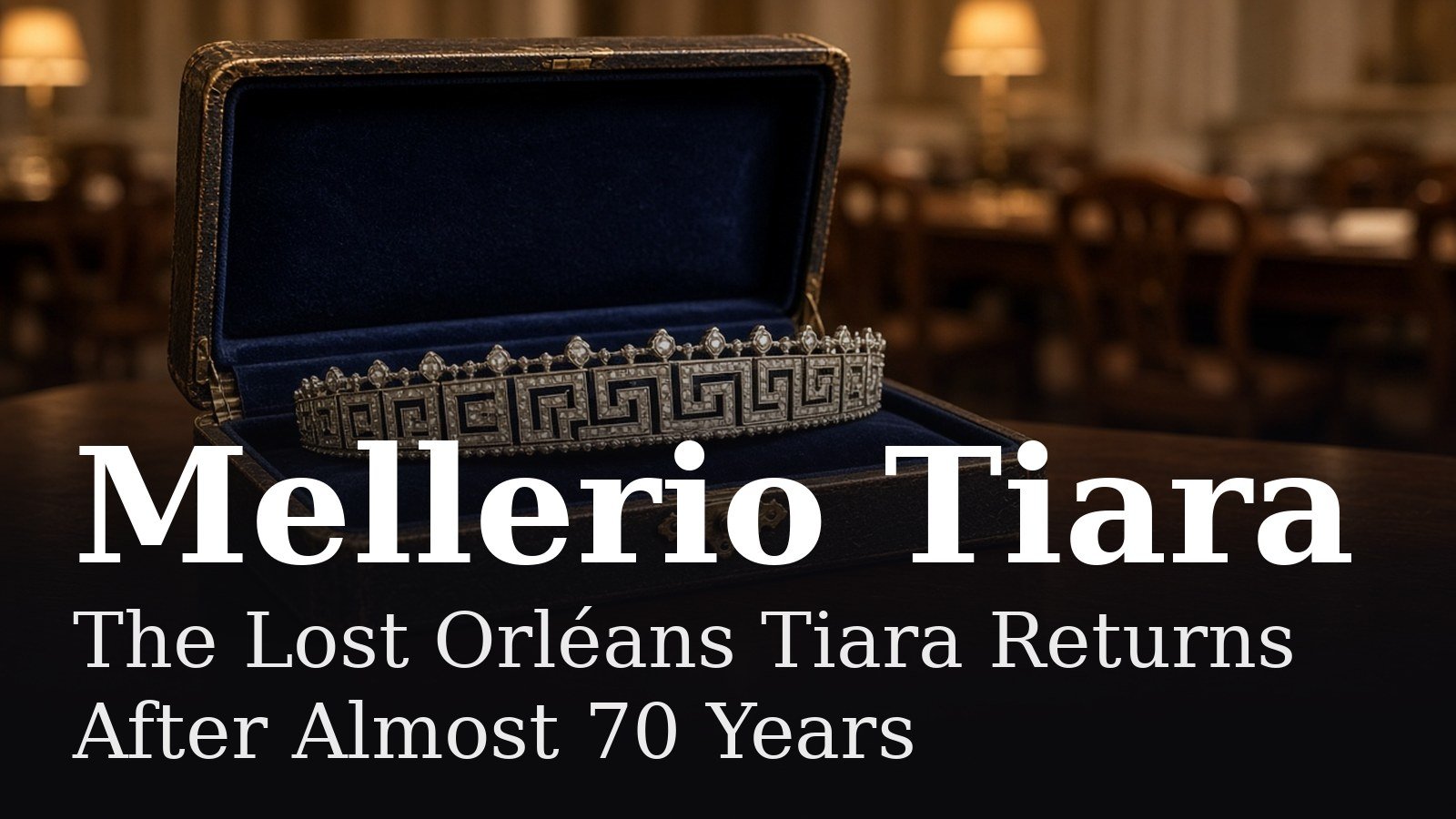
A diamond tiara made for a French princess who never became queen, last seen in public in 1957, is about to go under the hammer. The Mellerio Orléans tiara is one of the stars of Sotheby’s Royal & Noble Jewels sale in Geneva on 11 November 2026, and its story, as Vanity Fair Italia tells it, reads like a period drama.
A Greek key fit for a queen-in-waiting
The piece was created by Mellerio dits Meller, the Paris house founded in 1613 and often described as France’s oldest jeweller, for the London International Exhibition of 1862. At a time when most jewellers favoured flowers and romantic motifs, Mellerio chose the Greek revival look then sweeping Europe. The bandeau is built from 21 Greek key (meander) links set with old-cut diamonds, topped by 21 solitaire diamonds and finished with rose-cut stones. Like many 19th-century court jewels, it was designed to work twice: the band detaches to be worn as a necklace.
In 1864 Antoine d’Orléans, Duke of Montpensier, and his wife, the Spanish Infanta Luisa Fernanda, bought it as a wedding present for their daughter Marie Isabelle. She was marrying her cousin Philippe, Count of Paris and claimant to the French throne, so the tiara was meant for a queen if the monarchy ever returned. It never did.
A secret marriage and a lost trail
After Marie Isabelle died in 1919, the tiara passed to her younger son Ferdinand, Duke of Montpensier, and on his death in 1924 to his Spanish widow. She wore it for the rest of her life. Its last known outing was the 1957 wedding of Henri d’Orléans, where, fearing thieves on the road, she reportedly travelled with the tiara wrapped in a bundle at her chauffeur’s feet. When she died soon afterwards, the family learned that she had secretly married her secretary, José María de Huarte, and left him everything. The Orléans family went to court to recover the tiara and lost.
Then it vanished. It turned up in a private collection in Germany, its history hidden by a translation slip that had turned the Spanish “Duque de Montpensier” into a German “Herzog von Montpellier”. Sotheby’s identified it, and the auction house gives an estimate of CHF 300,000 to 500,000.
Wearing a little of that spirit
Few of us will bid in Geneva, but the idea behind this jewel, one piece that changes with the occasion, is easy to borrow. A sparkling necklace paired with matching earrings, a coordinated jewellery set or a fine bracelet can carry you from day to evening. You can explore the full jewellery collection on beebre.com.
Sources: Vanity Fair Italia (Giorgia Olivieri, 10 November 2026); Sotheby’s, Royal & Noble Jewels, Geneva, 11 November 2026; Mellerio press release (10 November 2026); JCK; Town & Country.