Most famous gemstones have been treasured for thousands of years. Tanzanite is different: it entered the jewellery world less than sixty years ago, yet it quickly became one of the most popular coloured stones on the market. Its story takes in a lucky find, a single small mining area and a clever piece of naming.
A discovery in the Merelani Hills
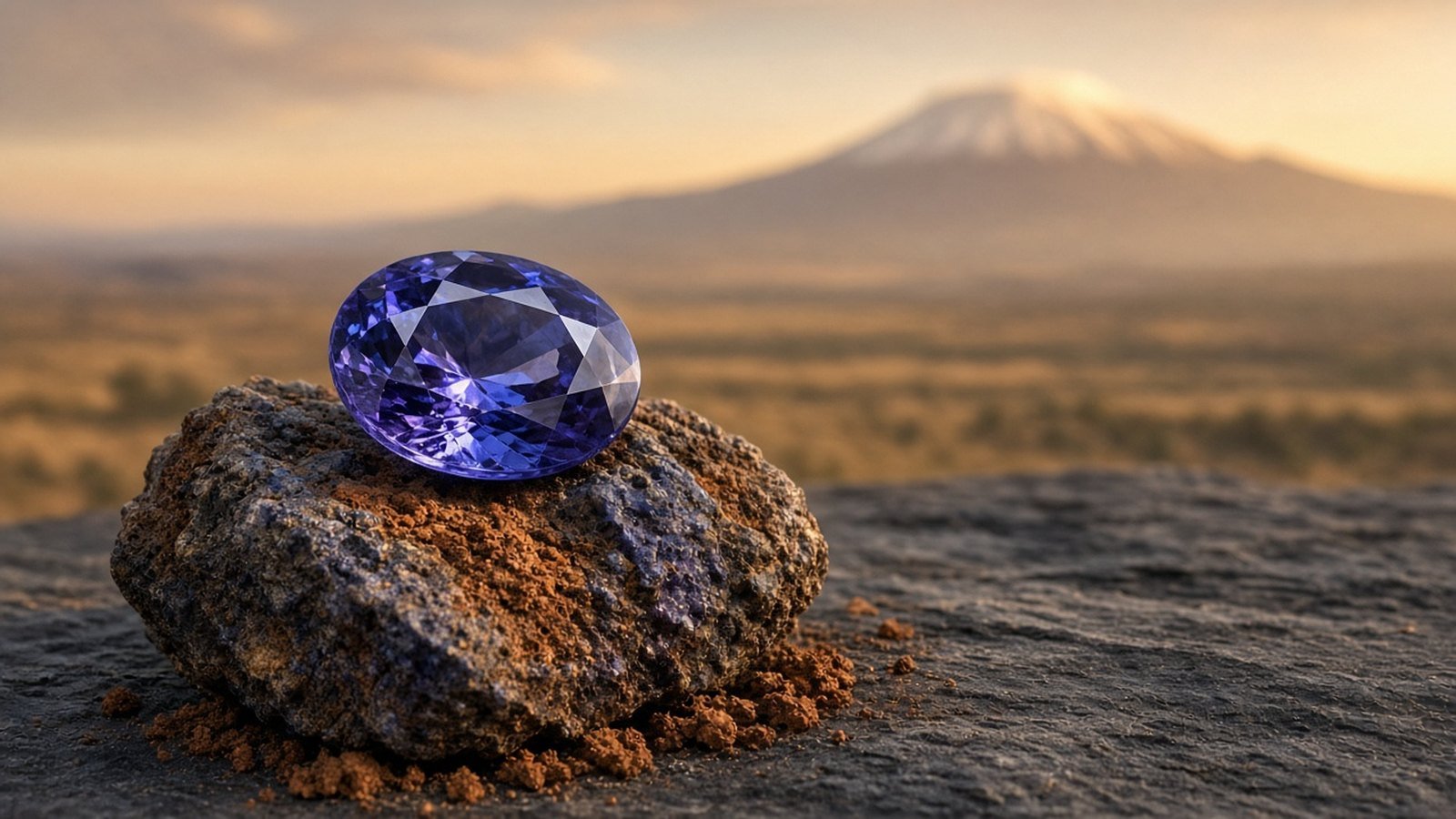
According to the Gemological Institute of America (GIA), blue stones from Tanzania had already been identified as the mineral zoisite in 1962, but the main source was only found in 1967. The usual account says that a Maasai herdsman, whom GIA names as Ali Juuyawatu, noticed transparent violet-to-blue crystals weathering out of the ground in Merelani, in northern Tanzania. He showed them to a prospector, Manuel d’Souza, who registered mining claims in the hope that he had found a new sapphire deposit. He had not. Within a short time around 90 more claims had appeared in an area of roughly 20 square miles, and the gem turned out to be a new variety of zoisite.
To this day, GIA notes, the hills of Merelani, close to Mount Kilimanjaro, are the only commercial source of tanzanite anywhere in the world.
Tiffany gives it a name
The trade name came from New York. GIA records that Tiffany & Co. saw the stone’s international appeal, became its main distributor and named it after its country of origin, launching a large publicity campaign in 1968. Its strong colour, high clarity and the chance of cutting large stones made it an almost instant success with designers and buyers. One impressive example, a 122.70-carat tanzanite, is now in the collection of the Smithsonian National Museum of Natural History in Washington.
Part of tanzanite’s charm is optical. It is strongly pleochroic, which means it shows different colours (blue, violet and purple tones) when viewed from different directions, so the cutter’s choice of orientation decides the final shade. GIA also explains that most stones are heat treated to bring out their blue-violet colour. With a hardness of about 6 to 7 on the Mohs scale, tanzanite is softer than sapphire, so it is best kept for pieces that avoid hard knocks, such as tanzanite stud earrings or tanzanite pendants.
From newcomer to birthstone
In 2002 tanzanite earned a place on the official list of modern birthstones. As JCK and National Jeweler reported, the American Gem Trade Association, together with Jewelers of America, added it as a birthstone for December, alongside turquoise and zircon, after a consensus among trade bodies. It is also the traditional gem for a 24th wedding anniversary. Not bad for a stone that was unknown to jewellers before the late 1960s. If you would like to see this violet-blue colour in a ring, take a look at our tanzanite rings.
Sources: Gemological Institute of America (GIA), “Tanzanite History and Lore”, “Tanzanite” and “December Birthstones”; JCK, “Tanzanite becomes a December birthstone”; National Jeweler, “Rocks On: The Evolution of the Birthstone List”.