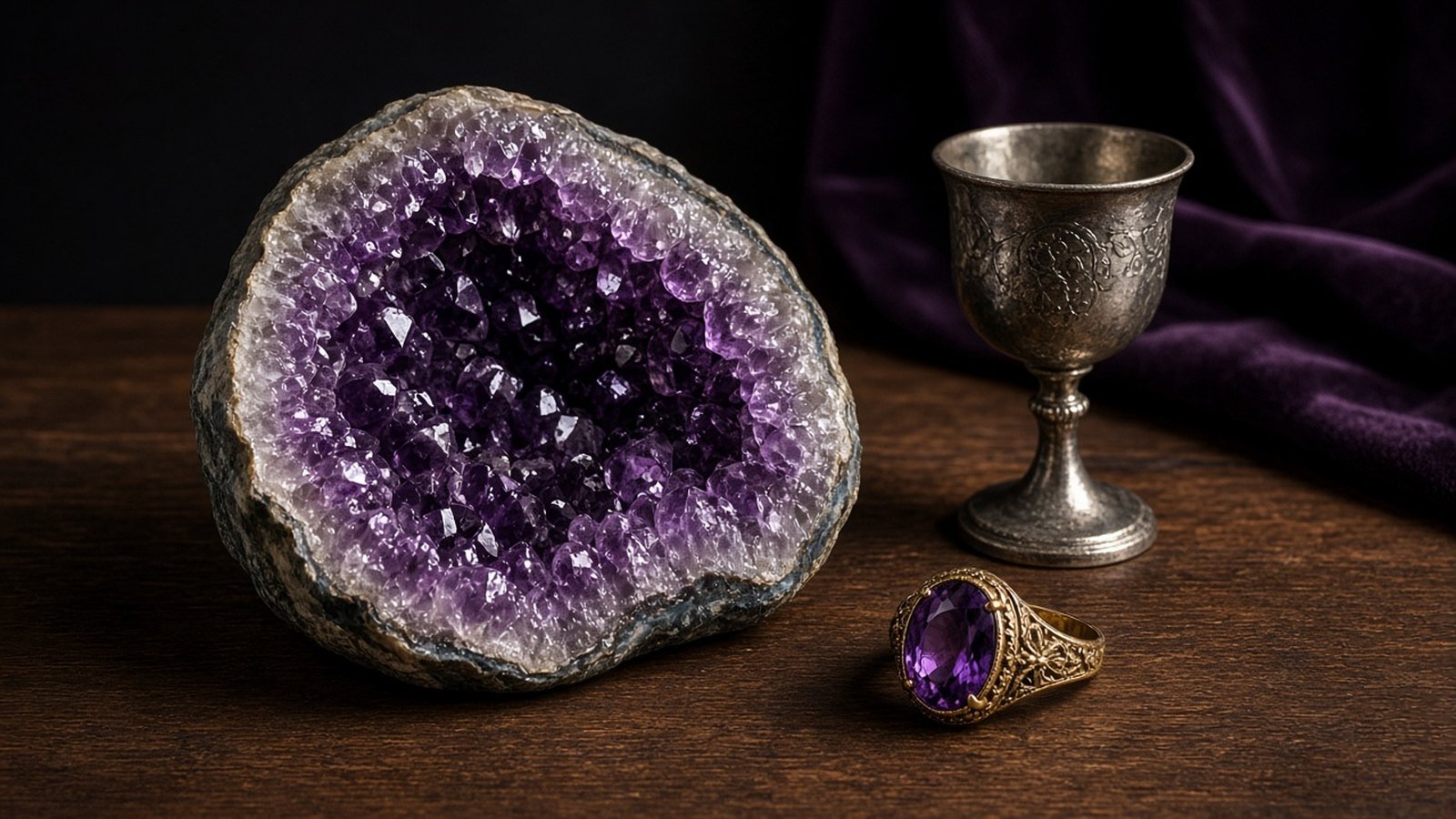
Today amethyst is one of the most popular and affordable coloured gemstones, but for most of its long history it sat among the most precious. According to the Gemological Institute of America (GIA), amethyst was once valued as highly as ruby, emerald and sapphire. Here is how a purple variety of quartz travelled from Greek drinking parties to bishops’ hands and royal jewel boxes.
A stone named for staying sober
The name comes from the ancient Greek amethystos, usually translated as “not drunk”. GIA explains that the gem’s wine-like colour linked it in Greek legend with Dionysus, the god of wine, whom the Romans called Bacchus. McGill University’s Office for Science and Society retells one version of the myth, in which a maiden turned into white stone is stained purple by the god’s wine. From such stories grew the belief that amethyst could guard against intoxication, and Greeks and Romans are said to have drunk from amethyst cups and worn amethyst amulets. As McGill drily notes, the stone did little to calm their famous feasts. GIA adds that people also believed it kept the wearer clear-headed in battle and in business.
Bishops, emperors and Siberian purple
That link with self-control carried amethyst into the Church. GIA notes that fine amethysts have long been set in religious jewellery, and the amethyst is still the traditional stone of a bishop’s ring. Purple has also long been a royal colour, and GIA points out that amethyst appears in the coronation regalia of British monarchs.
For centuries Russia was the main source of fine stones. A Sotheby’s catalogue note records that, at the request of Empress Catherine the Great, some of the finest amethysts were mined in the Ural Mountains, prized for a rich violet colour by day and reddish flashes by candlelight. Deep stones are still sometimes called “Siberian” amethyst.
Brazil changes everything
The picture changed in the 19th century. GIA reports that large deposits were found in Brazil, and a gem once as rare as ruby or emerald was suddenly plentiful. Brazil remains a major producer, especially the southern state of Rio Grande do Sul, where amethyst can form inside hollow geodes big enough to stand in. Bolivia’s Anahí mine is famous for ametrine, a natural mix of amethyst and citrine in one crystal.
The upside is that fine purple colour is now within easy reach. If you would like a piece of that history, browse our amethyst rings, from the antique-inspired Natural Amethyst Vintage Oval Ring to the Natural Amethyst Pear Halo Ring, or see our ametrine rings.
Sources: Gemological Institute of America (GIA), “Amethyst”, “Amethyst History and Lore” and “February Birthstone”; McGill University Office for Science and Society, “A Tryst with Amethyst”; Sotheby’s, catalogue note for an amethyst and diamond demi-parure (Magnificent Jewels and Noble Jewels, Geneva, 2013).