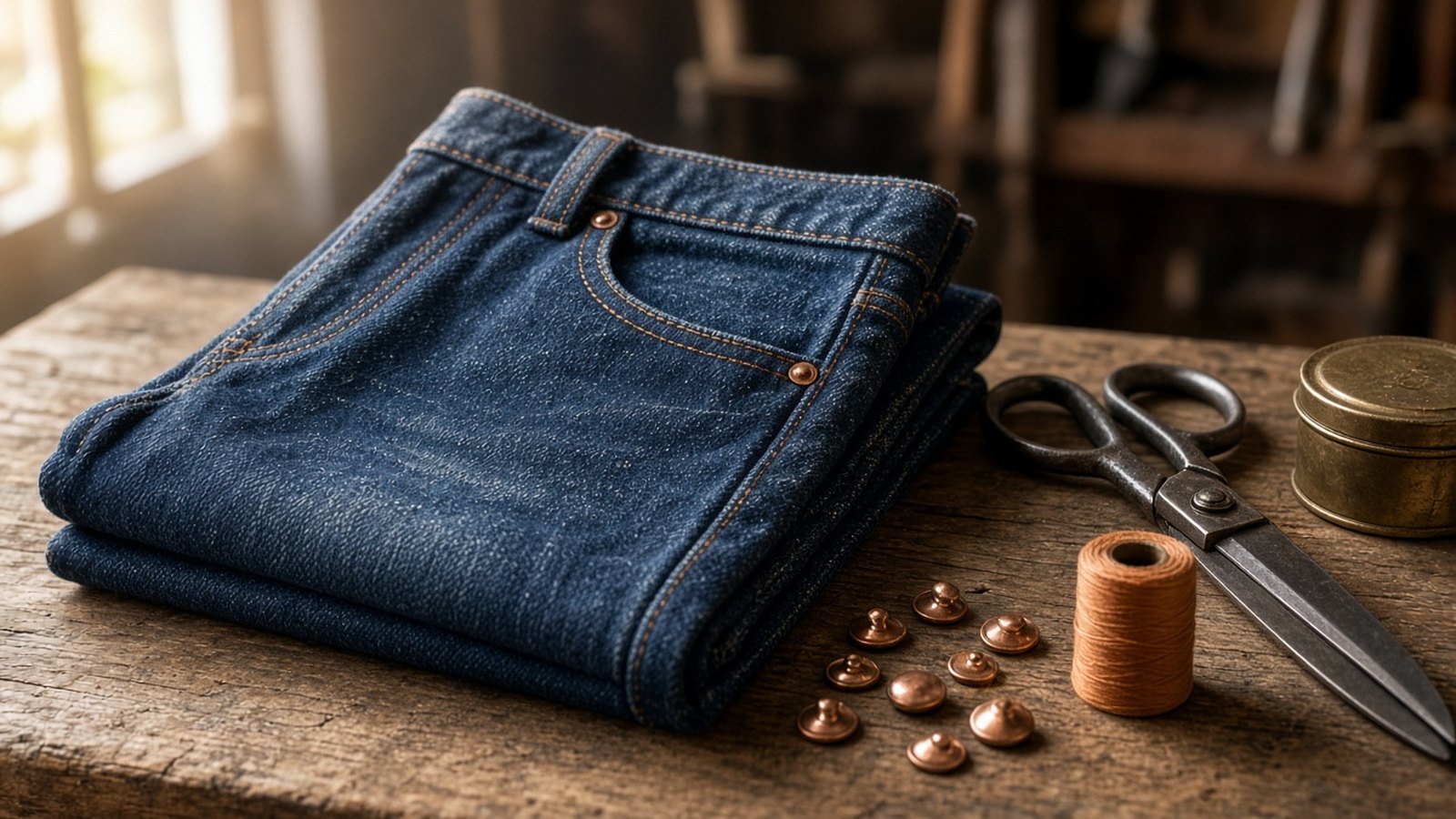
Few garments have travelled as far as blue jeans. They began as hard-wearing work trousers in the American West and ended up in almost every wardrobe in the world. The turning point came from a small, practical idea: a few copper rivets.
A tailor, a merchant and a patent
According to the Smithsonian’s National Museum of American History, Levi Strauss was a Bavarian-born merchant who moved to San Francisco in 1853 to sell dry goods to stores across the West. In 1872 he received a letter from Jacob Davis, a tailor in Reno, Nevada. A customer kept tearing the pockets of his work trousers, so Davis had started fixing the weak points with metal rivets. The trousers sold so well that Davis feared rivals would copy them, and he asked Strauss to help pay for a patent in return for a share of the rights.
US Patent No. 139,121, for an “improvement in fastening pocket-openings”, was granted on 20 May 1873. The patent text explains that a rivet at each edge of the pocket takes the strain off the thread, so the seams no longer rip. Production began straight away in San Francisco, first in tough cotton duck canvas and later mainly in blue denim.
From “waist overalls” to jeans
For decades nobody called them jeans. The company’s own history notes that the trousers were sold as “waist overalls”, and the famous 501 lot number only appeared around 1890, when the rivet patent passed into the public domain and other makers could copy the design. In 1934 the company introduced its first jeans for women, at a time when trousers for women were still far from mainstream.
The rebel’s uniform
After the Second World War, denim moved from the workplace into leisure. Films such as The Wild One (1953) and Rebel Without a Cause (1955) linked jeans with a restless, independent youth, and some schools even banned them from classrooms. Teenagers called them “jeans”, and by 1960 the company had dropped the word “overalls” from its advertising and labels. Since then, denim has stood for rebellion, protest, comfort and, eventually, simply everyday style.
A good pair of jeans still works as a blank canvas. Their deep indigo blue sits naturally with blue stones, whether that’s a pair of sapphire earrings, one of our sapphire bracelets or a simple piece from our pendant necklaces.
Sources: Smithsonian National Museum of American History, “Levi’s Brown Duck Trousers” (collection record); US Patent No. 139,121, “Improvement in Fastening Pocket-Openings” (20 May 1873); Levi Strauss & Co., “History of the Levi’s 501 Jeans”, company timeline and “A Short History of Denim” by historian Lynn Downey.