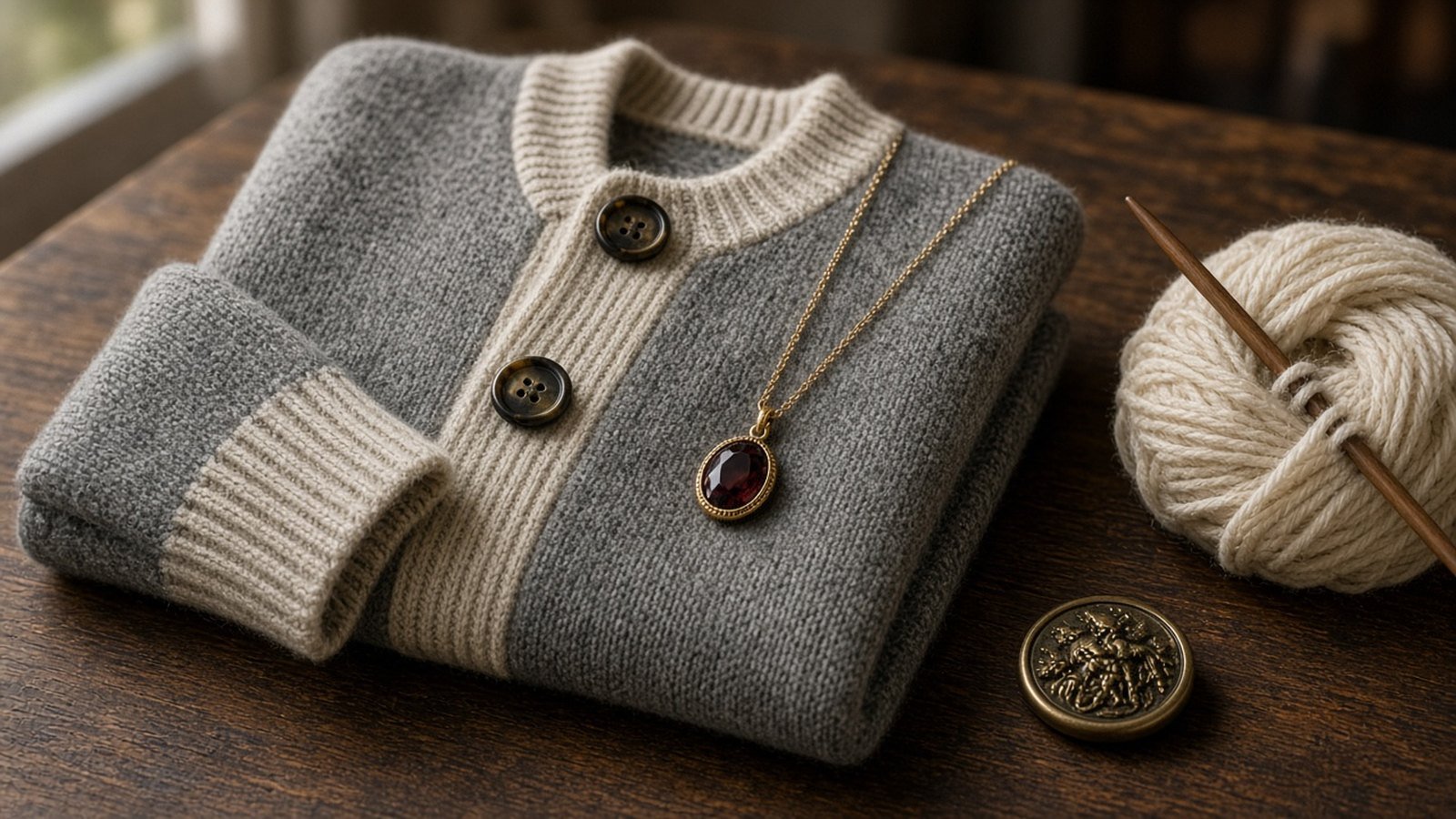
Few garments feel as gentle as the cardigan, yet its name comes from one of the most famous military disasters in British history. Together with the raglan sleeve and the balaclava, it is one of three pieces of everyday clothing whose names trace back to the Crimean War of the 1850s.
A cold war in the Crimea
The Battle of Balaclava was fought on 25 October 1854, and it included the Charge of the Light Brigade, led by James Brudenell, 7th Earl of Cardigan. The winter that followed was bitterly cold and damp, and officers wore knitted woollen jackets to keep warm. The language site World Wide Words notes that the garment was not Lord Cardigan’s invention, but his name became attached to it because he was the best-known figure of the war when he returned to Britain. The Online Etymology Dictionary records the word “cardigan” for a close-fitting knitted jacket from 1868, the year the earl died.
The same campaign named two more items. Lord Raglan, the British commander, had lost his right arm at Waterloo, and according to HistoryNet he favoured a loose overcoat whose sleeves ran in one piece up to the collar. That cut lives on as the raglan sleeve. Knitted head coverings sent out to the troops later took the name of Balaclava itself, the town near Sevastopol that served as the British base.
From uniform to wardrobe staple
The cardigan moved into women’s fashion in the early twentieth century. The Kyoto Costume Institute says Gabrielle Chanel introduced jersey cardigan suits in 1916, using a fabric that until then had mostly been used for underwear. The Victoria and Albert Museum describes how Chanel promoted knitted jersey as everyday wear through the 1920s, and how the Scottish knitwear firm Pringle claimed to have invented the twinset, a matching jumper and cardigan, in the 1930s. The BBC reports that Pringle hired Otto Weisz as its first industrial designer in 1934, and that the twinset became a favourite of film stars such as Grace Kelly.
The cardigan has kept reinventing itself since. In 2019, the olive-green cardigan Kurt Cobain wore for Nirvana’s 1993 MTV Unplugged performance sold for $334,000 at Julien’s Auctions in New York, which Guinness World Records lists as the most expensive sweater or cardigan ever sold at auction.
A soft knit and a single coloured stone remain an easy autumn pairing. A deep red garnet, like our natural garnet vintage halo pendant, sits neatly in the open neckline of a cardigan, and you can find more ideas among our garnet pendants and earrings.
Sources: World Wide Words, “Cardigan”; Online Etymology Dictionary, “cardigan”; HistoryNet, “Fighting Words: Words Coined During the Crimean War”; Kyoto Costume Institute digital archive, Chanel day ensemble c. 1928; Victoria and Albert Museum, “A history of sweaters”; BBC News, “Diamonds are forever: 200 years of Pringle of Scotland” (2015); Guinness World Records, “Most expensive sweater/cardigan sold at auction”; The Guardian (26 October 2019).