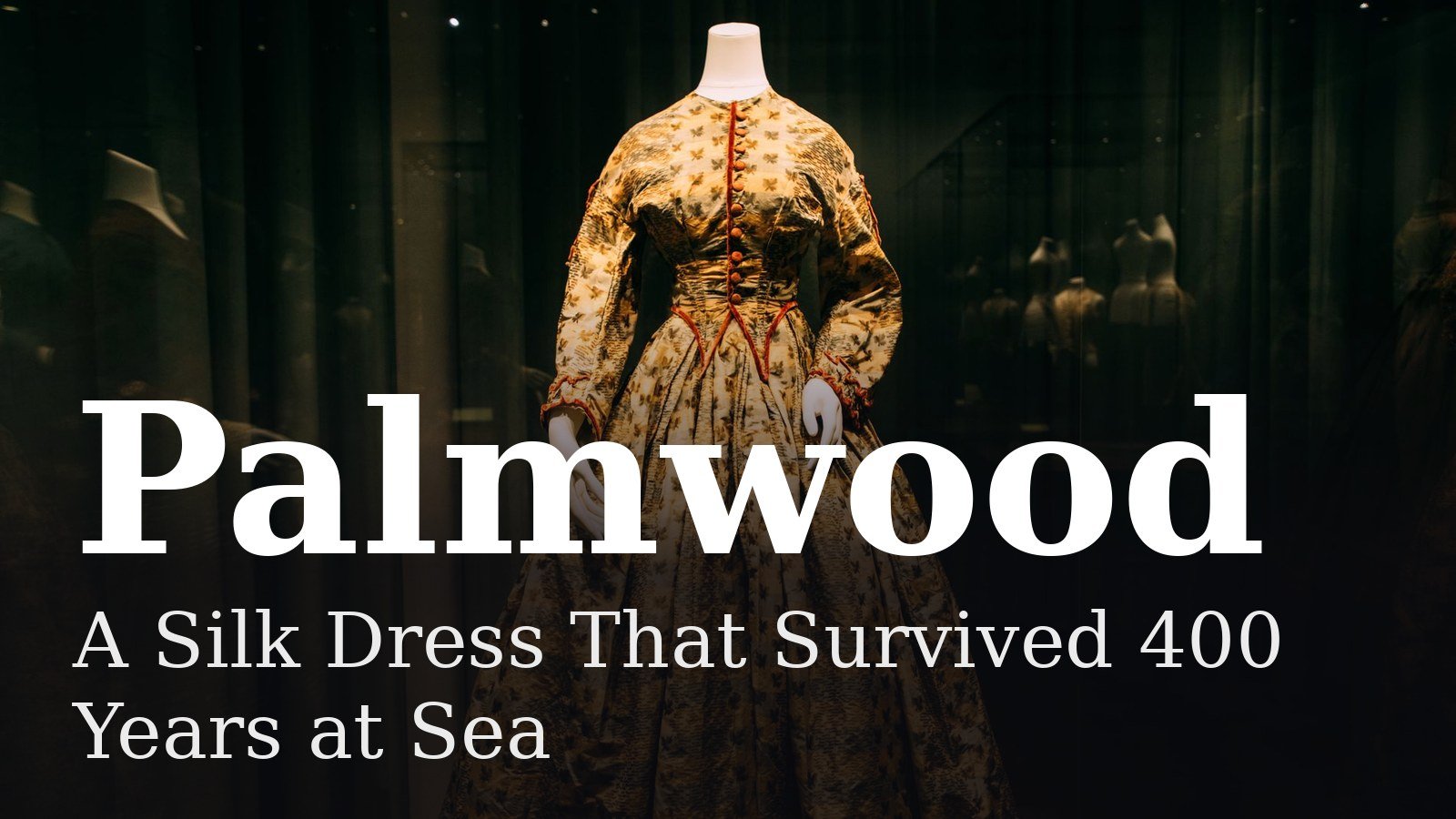
Very little everyday clothing survives from the early 1600s. That is what makes the so-called Palmwood dress so remarkable: a silk gown that spent almost four centuries on the seabed off the Dutch island of Texel and came back up nearly whole. Vanity Fair Italia has revisited its story this week, and it is one of the most extraordinary finds in the history of fashion.
A wardrobe in a shipwreck
Local divers discovered the wreck of a 17th-century merchant ship in the Wadden Sea in 2014. It became known as the Palmwood wreck after its cargo of boxwood, called palmhout in Dutch. Among the finds were chests holding a strikingly personal collection: fine silverware, leather book covers from a small library, shoes, stockings, a bodice and an embroidered toilette set with a purse, comb and mirror. The silk dress itself made international headlines in 2016.
Made of silk damask with a floral pattern, the gown has a fitted bodice, a full pleated skirt, sleeves and frills, and its style places it around 1620 to 1630. According to Museum Kaap Skil on Texel, which now cares for the collection, the costly materials suggest an owner from the very top of society. Even so, it was probably a dress for ordinary days rather than court occasions, which would have called for far more silver and gold thread.
A mystery still unsolved
For a while the dress was linked to Jean Kerr, a Scottish countess, but that theory was later rejected, partly because her baggage ship is recorded as sinking elsewhere. Who owned the gown, why it was on board and where it was going all remain unknown. Even its original colour is uncertain: dyes can fade under water, and other fabrics in the same chest may have stained it.
It survived because the wreck acted like a time capsule. Buried in sediment, in darkness and with very little oxygen, the silk was protected from the processes that normally destroy textiles. Once raised, that protection was gone, so the museum, working with the University of Amsterdam and the Cultural Heritage Agency of the Netherlands, developed special oxygen-free display cases. In effect, the dress is kept as though it had never left the wreck.
Heirlooms worth keeping
The Palmwood finds are a reminder that the things we treasure most are often the personal ones: a favourite dress, a hand mirror, a piece of silver. If that idea appeals, our jewellery collection is full of pieces made to be kept, from pendant necklaces to matching jewellery sets and classic earrings.
Sources: Vanity Fair Italia (20 October 2026); Museum Kaap Skil, “The Dress” and “17th century wedding dress unveiled” (kaapskil.nl); Cultural Heritage Agency of the Netherlands, MaSS database entry Burgzand Noord 17; University of Amsterdam, “Treasures from the Sea” (AHM Conference 2024); Huis van Hilde, “The Silk Dress and the Shipwreck”. Featured photo: historical dress in a museum by Shuxuan Cao via Pexels (illustrative, not the Palmwood dress).